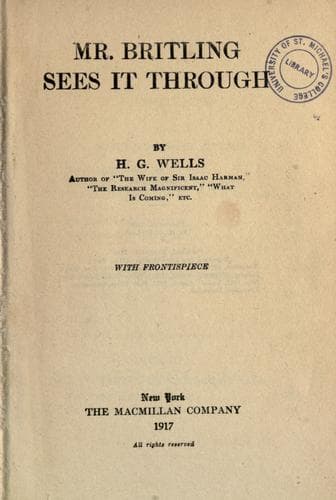
Mr. Britling Sees It ThroughWells, H. G. (Herbert George)
General
Mr. Britling Sees It Through
Wells, H. G. (Herbert George)
War stories; World War, 1914-1918 -- Fiction
These were thoughts that Mr. Britling had never faced before the war.
They came to him now, and they came only to be rejected by the inherent
quality of his mind. For weeks, consciously and subconsciously, his mind
had been grappling with this riddle. He had thought of it during his
lonely prowlings as a special constable; it had flung itself in
monstrous symbols across the dark canvas of his dreams. "Is there indeed
a devil of pure cruelty? Does any creature, even the very cruellest of
creatures, really apprehend the pain it causes, or inflict it for the
sake of the infliction?" He summoned a score of memories, a score of
imaginations, to bear their witness before the tribunal of his mind. He
forgot cold and loneliness in this speculation. He sat, trying all
Being, on this score, under the cold indifferent stars.
He thought of certain instances of boyish cruelty that had horrified him
in his own boyhood, and it was clear to him that indeed it was not
cruelty, it was curiosity, dense textured, thick skinned, so that it
could not feel even the anguish of a blinded cat. Those boys who had
wrung his childish soul to nigh intolerable misery, had not indeed been
tormenting so much as observing torment, testing life as wantonly as one
breaks thin ice in the early days of winter. In very much cruelty the
real motive is surely no worse than that obtuse curiosity; a mere step
of understanding, a mere quickening of the nerves and mind, makes it
impossible. But that is not true of all or most cruelty. Most cruelty
has something else in it, something more than the clumsy plunging into
experience of the hobbledehoy; it is vindictive or indignant; it is
never tranquil and sensuous; it draws its incentive, however crippled
and monstrous the justification may be, from something punitive in man's
instinct, something therefore that implies a sense, however misguided,
of righteousness and vindication. That factor is present even in spite;
when some vile or atrocious thing is done out of envy or malice, that
envy and malice has in it always--_always?_ Yes, always--a genuine
condemnation of the hated thing as an unrighteous thing, as an unjust
usurpation, as an inexcusable privilege, as a sinful overconfidence.
Those men in the airship?--he was coming to that. He found himself
asking himself whether it was possible for a human being to do any cruel
act without an excuse--or, at least, without the feeling of
excusability. And in the case of these Germans and the outrages they had
committed and the retaliations they had provoked, he perceived that
always there was the element of a perceptible if inadequate
justification. Just as there would be if presently he were to maltreat a
fallen German airman. There was anger in their vileness. These Germans
were an unsubtle people, a people in the worst and best sense of the
words, plain and honest; they were prone to moral indignation; and moral
indignation is the mother of most of the cruelty in the world. They
Public-domain text, read in full here on John Shaqi.
Reviews
Reviews
No reviews yet
Be the first to share your thoughts on this work.
Elsewhere in the archive
Join the Discussion
Join the discussion
Sign in to leave a comment or review.
Sign InorCreate an account