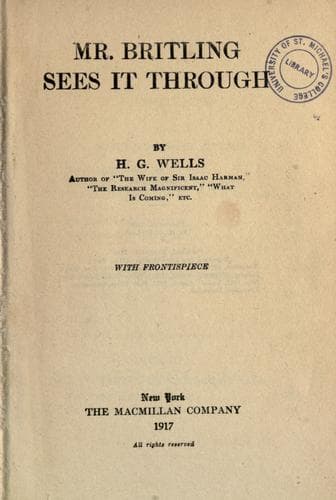
Mr. Britling Sees It ThroughWells, H. G. (Herbert George)
General
Mr. Britling Sees It Through
Wells, H. G. (Herbert George)
War stories; World War, 1914-1918 -- Fiction
perceived the indolence of the English and Russians, they perceived
their disregard of science and system, they could not perceive the
longer reach of these greater races, and it seemed to them that the
mission of Germany was to chastise and correct this laxity. Surely, they
had argued, God was not on the side of those who kept an untilled field.
So they had butchered these old ladies and slaughtered these children
just to show us the consequences:
"All along of dirtiness, all along of mess,
All along of doing things rather more or less."
The very justification our English poet has found for a thousand
overbearing actions in the East! "Forget not order and the real," that
was the underlying message of bomb and gas and submarine. After all,
what right had we English _not_ to have a gun or an aeroplane fit to
bring down that Zeppelin ignominiously and conclusively? Had we not
undertaken Empire? Were we not the leaders of great nations? Had we
indeed much right to complain if our imperial pose was flouted? "There,
at least," said Mr. Britling's reason, "is one of the lines of thought
that brought that unseen cruelty out of the night high over the houses
of Filmington-on-Sea. That, in a sense, is the cause of this killing.
Cruel it is and abominable, yes, but is it altogether cruel? Hasn't it,
after all, a sort of stupid rightness?--isn't it a stupid reaction to an
indolence at least equally stupid?"
What was this rightness that lurked below cruelty? What was the
inspiration of this pressure of spite, this anger that was aroused by
ineffective gentleness and kindliness? Was it indeed an altogether evil
thing; was it not rather an impulse, blind as yet, but in its ultimate
quality _as good as mercy_, greater perhaps in its ultimate values than
mercy?
This idea had been gathering in Mr. Britling's mind for many weeks; it
had been growing and taking shape as he wrote, making experimental
beginnings for his essay, "The Anatomy of Hate." Is there not, he now
asked himself plainly, a creative and corrective impulse behind all
hate? Is not this malignity indeed only the ape-like precursor of the
great disciplines of a creative state?
The invincible hopefulness of his sanguine temperament had now got Mr.
Britling well out of the pessimistic pit again. Already he had been on
the verge of his phrase while wandering across the rushy fields towards
Market Saffron; now it came to him again like a legitimate monarch
returning from exile.
"When hate shall have become creative energy....
"Hate which passes into creative power; gentleness which is indolence
and the herald of euthanasia....
"Pity is but a passing grace; for mankind will not always be pitiful."
But meanwhile, meanwhile.... How long were men so to mingle wrong with
right, to be energetic without mercy and kindly without energy?...
For a time Mr. Britling sat on the lonely parade under the stars and in
the sound of the sea, brooding upon these ideas.
Public-domain text, read in full here on John Shaqi.
Reviews
Reviews
No reviews yet
Be the first to share your thoughts on this work.
Elsewhere in the archive
Join the Discussion
Join the discussion
Sign in to leave a comment or review.
Sign InorCreate an account