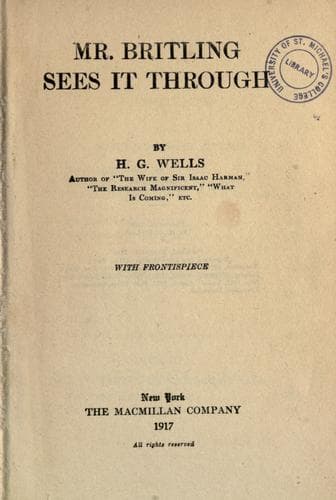
Mr. Britling Sees It ThroughWells, H. G. (Herbert George)
General
Mr. Britling Sees It Through
Wells, H. G. (Herbert George)
War stories; World War, 1914-1918 -- Fiction
"It's not easy a-parting," he said to Mr. Britling as the train slipped
down the line. "There's been many a parting hea' since this here old war
began. Many. And some as won't come back again neether."
Section 10
For some days Mr. Britling could think of nothing but Hugh, and always
with a dull pain at his heart. He felt as he had felt long ago while he
had waited downstairs and Hugh upstairs had been under the knife of a
surgeon. But this time the operation went on and still went on. At the
worst his boy had but one chance in five of death or serious injury, but
for a time he could think of nothing but that one chance. He felt it
pressing upon his mind, pressing him down....
Then instead of breaking under that pressure, he was released by the
trick of the sanguine temperament. His mind turned over, abruptly, to
the four chances out of five. It was like a dislocated joint slipping
back into place. It was as sudden as that. He found he had adapted
himself to the prospect of Hugh in mortal danger. It had become a fact
established, a usual thing. He could bear with it and go about his
affairs.
He went up to London, and met other men at the club in the same
emotional predicament. He realised that it was neither very wonderful
nor exceptionally tragic now to have a son at the front.
"My boy is in Gallipoli," said one. "It's tough work there."
"My lad's in Flanders," said Mr. Britling. "Nothing would satisfy him
but the front. He's three months short of eighteen. He misstated his
age."
And they went on to talk newspaper just as if the world was where it had
always been.
But until a post card came from Hugh Mr. Britling watched the postman
like a lovesick girl.
Hugh wrote more frequently than his father had dared to hope, pencilled
letters for the most part. It was as if he was beginning to feel an
inherited need for talk, and was a little at a loss for a sympathetic
ear. Park, his schoolmate, who had enlisted with him, wasn't, it seemed,
a theoriser. "Park becomes a martinet," Hugh wrote. "Also he is a
sergeant now, and this makes rather a gulf between us." Mr. Britling had
the greatest difficulty in writing back. There were many grave deep
things he wanted to say, and never did. Instead he gave elaborate
details of the small affairs of the Dower House. Once or twice, with a
half-unconscious imitation of his boy's style, he took a shot at the
theological and philosophical hares that Hugh had started. But the
exemplary letters that he composed of nights from a Father to a Son at
War were never written down. It was just as well, for there are many
things of that sort that are good to think and bad to say....
Public-domain text, read in full here on John Shaqi.
Reviews
Reviews
No reviews yet
Be the first to share your thoughts on this work.
Elsewhere in the archive
Join the Discussion
Join the discussion
Sign in to leave a comment or review.
Sign InorCreate an account