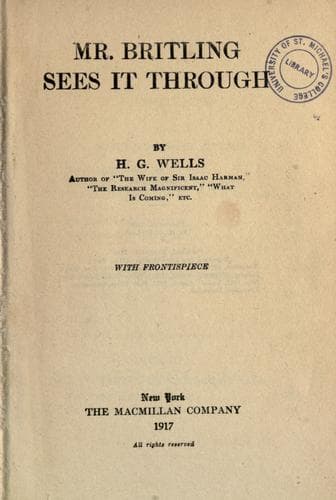
Mr. Britling Sees It ThroughWells, H. G. (Herbert George)
General
Mr. Britling Sees It Through
Wells, H. G. (Herbert George)
War stories; World War, 1914-1918 -- Fiction
Hugh was not very explicit about his position or daily duties. What he
wrote now had to pass through the hands of a Censor, and any sort of
definite information might cause the suppression of his letter. Mr.
Britling conceived him for the most part as quartered some way behind
the front, but in a flat, desolated country and within hearing of great
guns. He assisted his imagination with the illustrated papers. Sometimes
he put him farther back into pleasant old towns after the fashion of
Beauvais, and imagined loitering groups in the front of cafés; sometimes
he filled in the obvious suggestions of the phrase that all the Pas de
Calais was now one vast British camp. Then he crowded the picture with
tethered horses and tents and grey-painted wagons, and Hugh in the
foreground--bare-armed, with a bucket....
Hugh's letters divided themselves pretty fairly between two main topics;
the first was the interest of the art of war, the second the reaction
against warfare. "After one has got over the emotion of it," he wrote,
"and when one's mind has just accepted and forgotten (as it does) the
horrors and waste of it all, then I begin to perceive that war is
absolutely the best game in the world. That is the real strength of war,
I submit. Not as you put it in that early pamphlet of yours; ambition,
cruelty, and all those things. Those things give an excuse for war, they
rush timid and base people into war, but the essential matter is the
hold of the thing itself upon an active imagination. It's such a big
game. Instead of being fenced into a field and tied down to one set of
tools as you are in almost every other game, you have all the world to
play and you may use whatever you can use. You can use every scrap of
imagination and invention that is in you. And it's wonderful.... But
real soldiers aren't cruel. And war isn't cruel in its essence. Only in
its consequences. Over here one gets hold of scraps of talk that light
up things. Most of the barbarities were done--it is quite clear--by an
excited civilian sort of men, men in a kind of inflamed state. The great
part of the German army in the early stage of the war was really an army
of demented civilians. Trained civilians no doubt, but civilians in
soul. They were nice orderly clean law-abiding men suddenly torn up by
the roots and flung into quite shocking conditions. They felt they were
rushing at death, and that decency was at an end. They thought every
Belgian had a gun behind the hedge and a knife in his trouser leg. They
saw villages burning and dead people, and men smashed to bits. They
lived in a kind of nightmare. They didn't know what they were doing.
They did horrible things just as one does them sometimes in dreams...."
He flung out his conclusion with just his mother's leaping
consecutiveness. "Conscript soldiers are the ruin of war.... Half the
Germans and a lot of the French ought never to have been brought within
ten miles of a battlefield.
Public-domain text, read in full here on John Shaqi.
Reviews
Reviews
No reviews yet
Be the first to share your thoughts on this work.
Elsewhere in the archive
Join the Discussion
Join the discussion
Sign in to leave a comment or review.
Sign InorCreate an account