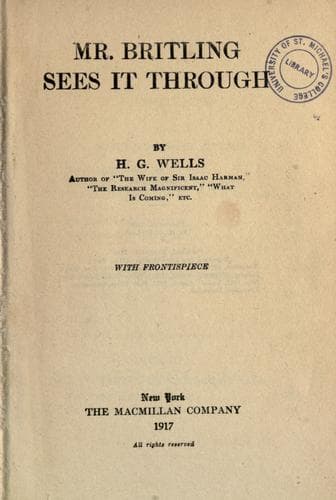
Mr. Britling Sees It ThroughWells, H. G. (Herbert George)
General
Mr. Britling Sees It Through
Wells, H. G. (Herbert George)
War stories; World War, 1914-1918 -- Fiction
great trouble to replace him, so that the garden became disagreeably
unkempt and unsatisfactory. He had to give up his frequent trips to
London. He was obliged to defer Statesminster for the boys. For a time
at any rate they must go as day boys to Brinsmead. At every point he met
this uncongenial consideration of ways and means. For years now he had
gone easy, lived with a certain self-indulgence. It was extraordinarily
vexatious to have one's greater troubles for one's country and one's son
and one's faith crossed and complicated by these little troubles of the
extra sixpence and the untimely bill.
What worried his mind perhaps more than anything else was his gradual
loss of touch with the essential issues of the war. At first the
militarism, the aggression of Germany, had seemed so bad that he could
not see the action of Britain and her allies as anything but entirely
righteous. He had seen the war plainly and simply in the phrase, "Now
this militarism must end." He had seen Germany as a system, as
imperialism and junkerism, as a callous materialist aggression, as the
spirit that makes war, and the Allies as the protest of humanity against
all these evil things.
Insensibly, in spite of himself, this first version of the war was
giving place to another. The tawdry, rhetorical German Emperor, who had
been the great antagonist at the outset, the last upholder of Cæsarism,
God's anointed with the withered arm and the mailed fist, had receded
from the foreground of the picture; that truer Germany which is thought
and system, which is the will to do things thoroughly, the Germany of
Ostwald and the once rejected Hindenburg, was coming to the fore. It
made no apology for the errors and crimes that had been imposed upon it
by its Hohenzollern leadership, but it fought now to save itself from
the destruction and division that would be its inevitable lot if it
accepted defeat too easily; fought to hold out, fought for a second
chance, with discipline, with skill and patience, with a steadfast
will. It fought with science, it fought with economy, with machines and
thought against all too human antagonists. It necessitated an implacable
resistance, but also it commanded respect. Against it fought three great
peoples with as fine a will; but they had neither the unity, the
habitual discipline, nor the science of Germany, and it was the latter
defect that became more and more the distressful matter of Mr.
Britling's thoughts. France after her initial experiences, after her
first reeling month, had risen from the very verge of defeat to a steely
splendour of resolution, but England and Russia, those twin slack
giants, still wasted force, were careless, negligent, uncertain.
Everywhere up and down the scale, from the stupidity of the uniform
sandbags and Hugh's young officer who would not use a map, to the
general conception and direction of the war, Mr. Britling's inflamed and
oversensitised intelligence perceived the same bad qualities for which
Public-domain text, read in full here on John Shaqi.
Reviews
Reviews
No reviews yet
Be the first to share your thoughts on this work.
Elsewhere in the archive
Join the Discussion
Join the discussion
Sign in to leave a comment or review.
Sign InorCreate an account