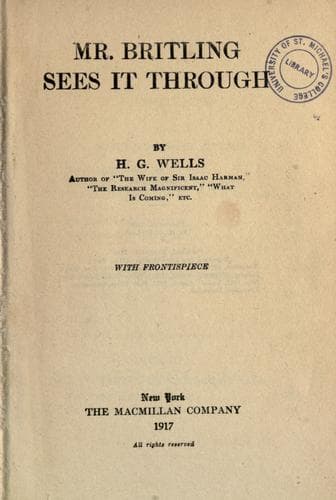
Mr. Britling Sees It ThroughWells, H. G. (Herbert George)
General
Mr. Britling Sees It Through
Wells, H. G. (Herbert George)
War stories; World War, 1914-1918 -- Fiction
he had so often railed upon his countrymen in the days of the peace,
that impatience, that indolence, that wastefulness and inconclusiveness,
that failure to grip issues and do obviously necessary things. The same
lax qualities that had brought England so close to the supreme
imbecility of a civil war in Ireland in July, 1914, were now muddling
and prolonging the war, and postponing, it might be for ever, the
victory that had seemed so certain only a year ago. The politician still
intrigued, the ineffectives still directed. Against brains used to the
utmost their fight was a stupid thrusting forth of men and men and yet
more men, men badly trained, under-equipped, stupidly led. A press
clamour for invention and scientific initiative was stifled under a
committee of elderly celebrities and eminent dufferdom; from the outset,
the Ministry of Munitions seemed under the influence of the "business
man."...
It is true that righteousness should triumph over the tyrant and the
robber, but have carelessness and incapacity any right to triumph over
capacity and foresight? Men were coming now to dark questionings
between this intricate choice. And, indeed, was our cause all
righteousness?
There surely is the worst doubt of all for a man whose son is facing
death.
Were we indeed standing against tyranny for freedom?
There came drifting to Mr. Britling's ears a confusion of voices, voices
that told of reaction, of the schemes of employers to best the trade
unions, of greedy shippers and greedy house landlords reaping their
harvest, of waste and treason in the very households of the Ministry, of
religious cant and intolerance at large, of self-advertisement written
in letters of blood, of forestalling and jobbery, of irrational and
exasperating oppressions in India and Egypt.... It came with a shock to
him, too, that Hugh should see so little else than madness in the war,
and have so pitiless a realisation of its essential futility. The boy
forced his father to see--what indeed all along he had been seeing more
and more clearly. The war, even by the standards of adventure and
conquest, had long since become a monstrous absurdity. Some way there
must be out of this bloody entanglement that was yielding victory to
neither side, that was yielding nothing but waste and death beyond all
precedent. The vast majority of people everywhere must be desiring
peace, willing to buy peace at any reasonable price, and in all the
world it seemed there was insufficient capacity to end the daily
butchery and achieve the peace that was so universally desired, the
peace that would be anything better than a breathing space for further
warfare.... Every day came the papers with the balanced story of
battles, losses, destructions, ships sunk, towns smashed. And never a
decision, never a sign of decision.
Public-domain text, read in full here on John Shaqi.
Reviews
Reviews
No reviews yet
Be the first to share your thoughts on this work.
Elsewhere in the archive
Join the Discussion
Join the discussion
Sign in to leave a comment or review.
Sign InorCreate an account