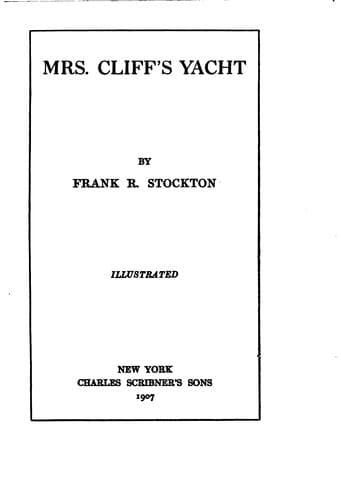
Rich people -- Fiction; Widows -- Fiction; Yachts -- Fiction
Mrs. Ferguson had also well-defined opinions upon the subject. She had
two daughters who were more than half grown, had learned all that they
could be taught in Plainton, and she was very anxious to send them away
to school, where their natural talents could be properly cultivated. She
felt that she owed a deep and solemn duty to these girls, and she had
already talked to Mrs. Cliff about them.
The latter had taken a great deal of interest in the matter, and
although she had not said she would help Mrs. Ferguson to properly
educate these girls, for she had not asked her help, she had taken so
much interest in the matter that their mother had great hopes. And if
this widow without any children felt inclined to assist the children of
others during her life, how much more willing would she be likely to be
to appropriate a portion of what she left behind her to such an object!
Mrs. Wells and Mrs. Archibald had solid claims upon Mrs. Cliff. It was
known that shortly after the death of her husband, when she found it
difficult to make collections and was very much in need of money for
immediate expenses, they had each made loans to her. It is true that
even before she started for South America she had repaid these loans
with full legal interest. But the two matrons could not forget that they
had been kind to her, nor did they believe that Mrs. Cliff had forgotten
what they had done, for the presents she had brought them from France
were generally considered as being more beautiful and more valuable than
those given to anybody else,--except the Thorpedykes and the Perleys.
This indicated a very gratifying gratitude upon which the two ladies,
each for herself, had every right to build very favorable hopes.
Miss Inchman and Mrs. Cliff had been school-fellows, and when they were
both grown young women there had been a good deal of doubt which one of
them William Cliff would marry. He made his choice, and Susan Inchman
never showed by word or deed that she begrudged him to her friend, to
whom she had always endeavored to show just as much kindly feeling as if
there had been two William Cliffs, and each of the young women had
secured one of them. If Mrs. Cliff, now a widow with money enough to
live well upon and keep a carriage, was making out her will, and was
thinking of her friends in Plainton, it would be impossible for her to
forget one who was the oldest friend of all.
So it is easy to see why she did not want to go to Mrs. Cliff and
prejudice her against herself, by stating that she ought to make a will
for the benefit of the old friends who had always loved and respected
her.
Miss Cushing now spoke. She knew what each member of the little company
was thinking about, and she felt that it might as well be spoken of.
Public-domain text, read in full here on John Shaqi.
Reviews
Reviews
No reviews yet
Be the first to share your thoughts on this work.
Join the Discussion
Join the discussion
Sign in to leave a comment or review.
Sign InorCreate an account