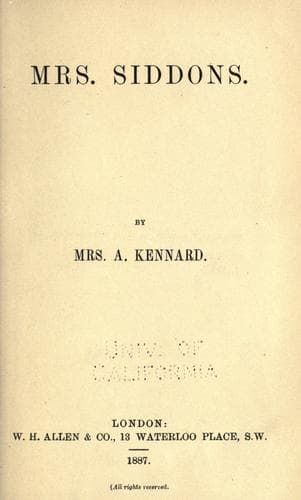
Actresses -- Great Britain -- Biography; Siddons, Sarah, 1755-1831
At last even her patience was worn out, and at the close of her brother’s
first year of management she retired from the theatre. Sheridan dared
to boast they could do without her. A scheme was then hatching in
the ever-fertile Irish brain of the proprietor that was destined to
revolutionise the dramatic world of London. He discovered that the taste
of the day, and the requirements of his own pocket, demanded a larger and
more luxurious building than Old Drury; the walls that had re-echoed to
the grand tones of Betterton, the musical love-making of Barry, and the
passionate declamation of Garrick, was to be pulled down to satisfy the
greed and the ambition of Sheridan. Immediate proposals for debentures
amounting to £160,000 were issued, and, wonderful to relate, taken up
in a very short time. But, alas! to cover the interest of this enormous
sum, it was determined to build a house nearly double the size. Neither
Mrs. Siddons nor her brother seems to have considered the disastrous
consequence this would exercise on their art. The perfect acoustics and
compact stage of the old house were to be swept away to give place to an
immense dome-shaped space, and an expanse requiring undignified energy of
motion to traverse. The immediate consequence was evident; recourse had
to be taken to stage artifice to manage the entrance and the exit, while
gesture had to be more violent, expression more exaggerated, and voice
unduly raised to produce an effect.
In Garrick’s Drury, also, the front row of boxes was open like a gallery,
and everyone who occupied them was obliged to appear in full dress.
The row of boxes above these again were given up to the _bourgeoisie_,
while the lattices at the top were the portion destined to those whose
reputation was doubtful, and who by their unseemly behaviour might
disturb the decorum of the audience. Garrick was master of his art, and
knew how to value the criticism and sympathy of the crowd. Under his
management the two-shilling gallery was brought down to a level with
the second row of boxes. By that arrangement a player had the mass of
the audience under his immediate control; and that mass, uninfluenced
by fashion or prejudice, unerring in its judgment, is the dread of an
inferior actor, the delight of a great one.
While the theatre was still in process of erection, the company performed
at the Opera House in the Haymarket, or, as it was called, the King’s
Theatre. The new house was opened on April 21st, 1794, with _Macbeth_.
“I am told,” Mrs. Siddons writes to Lady Harcourt, “that the banquet is
a thing to go and see of itself. The scenes and dresses all new, and as
superb and characteristic as it is possible to make them. You cannot
conceive what I feel at the prospect of playing there. I daresay I shall
be so nervous as scarcely to be able to make myself heard in the first
scene.”
This banquetting scene in _Macbeth_ was made the subject of sarcastic
hints in the daily press on the old score of her avarice:—
Public-domain text, read in full here on John Shaqi.
Reviews
Reviews
No reviews yet
Be the first to share your thoughts on this work.
Elsewhere in the archive
Join the Discussion
Join the discussion
Sign in to leave a comment or review.
Sign InorCreate an account