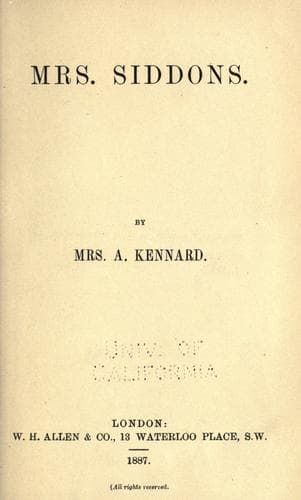
Actresses -- Great Britain -- Biography; Siddons, Sarah, 1755-1831
His really great gift was his large and cultivated understanding, that
enabled him to grasp the spirit of the author he sought to interpret,
giving a new emphasis and truth to scenes that were hackneyed and stale
by a conventional method of rendering. This was particularly the case
with Shakespeare, whose beauties he and his sister first revealed to
their generation. The difference, however, between them was that he
possessed superlative talent, she possessed genius. In speaking to
Reynolds the dramatist, she defined completely the difference between
them, “My brother John, in his most impetuous bursts, is always careful
to avoid any discomposure of his dress or deportment, but in the
whirlwind of passion I lose all thoughts of such matters.”
He is said to have nourished a tender affection for the
“Muse”—beautiful, clever, fascinating, stuttering Mrs. Inchbald.
When her husband died, it was universally said he would marry her.
Fanny Kemble tells an incident that occurred long after Kemble was
married. Mrs. Inchbald and Miss Mellon were sitting by the fire-place
in the green-room, waiting to be called upon the stage. The two were
laughingly discussing their male friends and acquaintances from the
matrimonial point of view. John Kemble, who was standing near, at length
jestingly said to Mrs. Inchbald, who had been comically energetic in her
declarations of whom she could or would or never could or would have
married, “Well, Mrs. Inchbald, would you have had me?” “Dear heart,” said
the stammering beauty, turning her sweet sunny face up to him, “I’d have
j-j-j-jumped at you!”
The lady he did eventually marry was no beauty and no “Muse,” but, much
to the indignation of Mrs. Siddons, as people said at the time, a very
ordinary young woman, daughter of a Mr. and Mrs. Hopkins, prompter and
actress at Drury Lane. Priscilla, however, made him a good wife, and he
never had cause to regret his choice.
The next brother to John, Stephen, although almost born on the stage, had
none of the requisites either of talent or facility to make him a good
actor. Only a few days before John’s first appearance in London, Stephen
appeared before the public as Othello. It was said that the manager had
made a mistake, and had engaged the “big” instead of the “great” Mr.
Kemble. Stephen’s great boast all his life was that he was the only actor
who could play Falstaff “without stuffing.” His qualifications were those
of a boon companion rather than of an actor. He very soon quitted the
London stage and became manager of a provincial theatre.
Public-domain text, read in full here on John Shaqi.
Reviews
Reviews
No reviews yet
Be the first to share your thoughts on this work.
Elsewhere in the archive
Join the Discussion
Join the discussion
Sign in to leave a comment or review.
Sign InorCreate an account