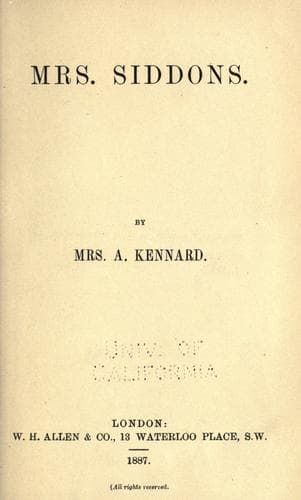
Actresses -- Great Britain -- Biography; Siddons, Sarah, 1755-1831
Frances, the great actress’s second sister, inherited a considerable
portion of the family beauty, but little dramatic power, and what she had
was rendered inoperative by her unconquerable shyness. Mrs. Siddons first
brought her out at Bath. The papers vented their spleen against the elder
sister on the younger. It was natural, they said, that she should wish to
bring her forward, but they hoped she had learned, by the utter failure
of her attempt, not to “cram incapable actresses down the throats of the
public.” One of the theatrical critics, Steevens, fell in love with her;
but his proposals being rejected, he became her bitterest enemy.
Mrs. Siddons writes to tell Dr. Whalley of this love affair:—“My sister
Frances is not married, and, I believe, there is very little reason to
suppose she will be soon. In point of circumstances, I believe, the
gentleman you mention would be a desirable husband; but I hear so much of
his ill-temper, and know so much of his caprice, that, though my sister,
I believe, likes him, I cannot wish her gentle spirit linked with his.”
Mrs. Siddons had judged her sister’s suitor exactly. The engagement
was soon broken off, and the girl married Mr. Twiss, another dramatic
critic, whom Fanny Kemble, in her _Records of a Girlhood_, describes
as a grim-visaged, gaunt-figured, kind-hearted gentleman and profound
scholar, who, it was said, at one time nourished a hopeless passion for
Mrs. Siddons. The Twisses later set up a genteel seminary at Bath, where
fashionable young ladies were sent “to be bettered.” Mrs. Twiss died in
October 1822, and Mr. Twiss in 1827. Mrs. Siddons ever kept up the most
affectionate intercourse with them, and their son Horace Twiss was her
favourite nephew.
Her next sister, Elizabeth, though apprenticed to a mantua-maker, was
soon bitten with the dramatic enthusiasm of the family. She obtained an
engagement through the influence of her famous sister, but made no way in
London; and after her marriage with Mr. Whitelock, one of the managers
of the Chester company, in 1785, she went with him to America, where she
seems to have had some success.
Public-domain text, read in full here on John Shaqi.
Reviews
Reviews
No reviews yet
Be the first to share your thoughts on this work.
Elsewhere in the archive
Join the Discussion
Join the discussion
Sign in to leave a comment or review.
Sign InorCreate an account