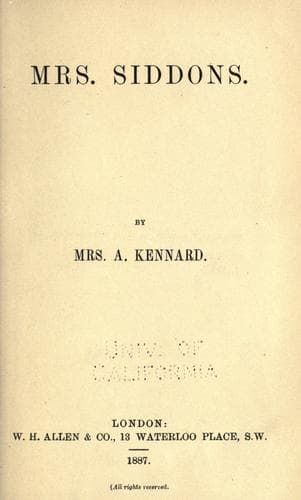
Actresses -- Great Britain -- Biography; Siddons, Sarah, 1755-1831
Mrs. Whitelock, we are told, was a taller and fairer woman than Mrs.
Siddons. When she returned to England years later, she wore an auburn
wig, which, like the tall cap that surmounted it, was always on one side.
She was a simple-hearted, sweet-tempered woman, but very imperfectly
educated. Her Kemble name, face, figure, and voice helped her in the
United States, but her own qualifications were but meagre. Nothing could
be droller, we are told, than to see her with Mrs. Siddons, of whom she
looked like a clumsy, badly-finished imitation. Her vehement gestures
and violent objurgations contrasted comically with her sister’s majestic
stillness of manner; and when occasionally Mrs. Siddons would interrupt
her with “Elizabeth, your wig is on one side,” and the other replied,
“Oh, is it?” and, giving the offending head-gear a shove, put it quite
as crooked in the other direction, and proceeded with her discourse,
Melpomene herself used to have recourse to her snuff-box to hide the
dawning smile on her face.
Another sister, Jane, appeared in Lady Randolph at Newcastle when
she was nineteen. She had all the Kemble faults in acting carried to
excess. She was, besides, short and fat; and when a character in the
play, describing her death, said, “She ran, she flew, like lightning
up the hill,” the audience roared with laughter. Shortly after this
discouraging attempt she married a Mr. Mason, of Edinburgh, and retired
from the profession. She died in 1834, leaving a husband, five sons,
and a daughter, who almost all went on the stage. With one unfortunate
exception, the Kemble family were remarkable for their decorous,
well-regulated lives. Although all the brothers married actresses, their
children were admirably brought up, and their households models of
propriety. The unfortunate exception we mentioned was Ann Curtis, the
fourth sister. To a woman of Mrs. Siddons’s proud, sensitive temper, the
vagaries of this wretched woman must have been painful beyond expression.
She was said to be lame, which prevented her going on the stage. In
1783, the year of her great triumph in London, the young actress had the
pleasure of reading in all the papers the following advertisement. Under
the guise of charity it is easy to see the motive that prompted it, and
shows the envy and malignity that pursued her during her career.
DONATIONS IN FAVOUR OF MRS. CURTIS, YOUNGEST SISTER OF MRS.
SIDDONS.
Public-domain text, read in full here on John Shaqi.
Reviews
Reviews
No reviews yet
Be the first to share your thoughts on this work.
Elsewhere in the archive
Join the Discussion
Join the discussion
Sign in to leave a comment or review.
Sign InorCreate an account