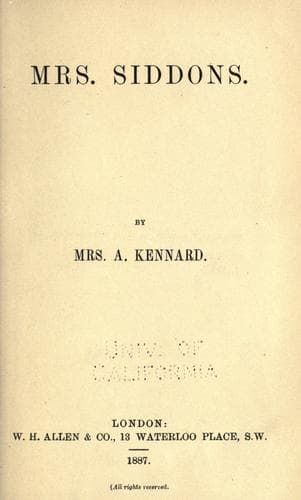
Actresses -- Great Britain -- Biography; Siddons, Sarah, 1755-1831
“Independently of any other consideration, it is a great object to me
to have a reasonable excuse for spending much of my remaining life in
the admired and beloved society of Scotland; I am therefore, on my _own_
account as _well_ as his, naturally anxious for the Success of my Son in
the Theatre, and I think I may without arrogance aver that you cou’d not
chuse better. He has great qualifications and wou’d not be the worse,
I apprehend, for my advice in respect to Dramatic business, or for the
pecuniary aid which I should be proud to afford in order to amplify the
costume of The Stage. His abilities as an Actor need not my eulogium, and
his private respectability is so universally acknowledged as to spare his
mother the pain of boasting. I have done my part, and trust the rest to
heaven! I have written to all you advis’d me to write to, and now in one
word let me thank you for your good counsel and assure you that whatever
be the result I shall for ever consider myself exceedingly oblig’d to
you. So much ambiguity and darkness seems to envelop the business (the
Galindo embroglio), however, that I know not what to wish—but that there
was an _end_ of both hopes and fears; since nothing is so insupportable
as Suspense.”
Those who serve the public have much to suffer from the caprices of
the crowd, but they also experience many proofs of the appreciation of
their genius by individuals. The Kembles met with instances of kindness
and friendliness at the moment of their need that strike one as almost
fabulous in their generosity. The Duke of Northumberland offered Kemble a
loan of ten thousand pounds on his simple bond. He hesitated to accept,
fearing his inability to pay the interest. The Duke promised he should
never be pressed for it, and on the day of the laying the first stone he
cancelled the bond, and made him a present of the whole sum.
Aided by the munificence of patrons, fifty thousand pounds was soon
subscribed; nearly the same amount was received from the insurance
companies, and on December 30th, 1808, the first stone was laid with
Masonic honours. John Kemble was not a person to do away with the pomp of
a ceremonial. All the actors and actresses were assembled; Mrs. Siddons,
wearing a nodding plume of ominous black feathers, while her brother, who
had risen from his sick bed, stood under the torrents of rain in white
silk stockings and pumps.
In less than a twelvemonth from the time of its destruction the new
theatre arose from the ashes of its predecessor. While it was building,
Drury Lane, the opposition house, under Sheridan’s management, was also
burnt to the ground, bringing down Sheridan with it in its ruin.
Public-domain text, read in full here on John Shaqi.
Reviews
Reviews
No reviews yet
Be the first to share your thoughts on this work.
Elsewhere in the archive
Join the Discussion
Join the discussion
Sign in to leave a comment or review.
Sign InorCreate an account