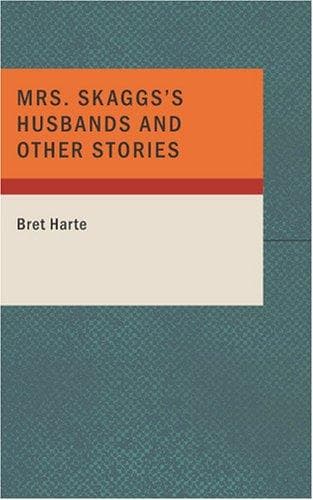
Mrs. Skagg's Husbands and Other StoriesHarte, Bret
General
Mrs. Skagg's Husbands and Other Stories
Harte, Bret
American fiction -- 19th century; Short stories; Western stories
The Old Man arose hurriedly and disappeared in the closet. Presently he
reappeared. “His rheumatiz is coming on agin bad,” he explained, “and
he wants rubbin'.” He lifted the demijohn of whiskey from the table
and shook it. It was empty. Dick Bullen put down his tin cup with
an embarrassed laugh. So did the others. The Old Man examined their
contents and said hopefully, “I reckon that's enough; he don't need
much. You hold on all o' you for a spell, and I'll be back”; and
vanished in the closet with an old flannel shirt and the whiskey. The
door closed but imperfectly, and the following dialogue was distinctly
audible:--
“Now, Sonny, whar does she ache worst?”
“Sometimes over yar and sometimes under yer; but it's most powerful from
yer to yer. Rub yer, dad.”
A silence seemed to indicate a brisk rubbing. Then Johnny:
“Hevin' a good time out yer, dad?”
“Yes, sonny.”
“To-morrer's Chrismiss, ain't it?”
“Yes, Sonny. How does she feel now?”
“Better rub a little furder down. Wot's Chrismiss, anyway? Wot's it all
about?”
“O, it's a day.”
This exhaustive definition was apparently satisfactory, for there was a
silent interval of rubbing. Presently Johnny again:
“Mar sez that everywhere else but yer everybody gives things to
everybody Chrismiss, and then she jist waded inter you. She sez thar's
a man they call Sandy Claws, not a white man, you know, but a kind o'
Chinemin, comes down the chimbley night afore Chrismiss and gives things
to chillern,--boys like me. Puts 'em in their butes! Thet's what she
tried to play upon me. Easy now, pop, whar are you rubbin' to,--thet's
a mile from the place. She jest made that up, didn't she, jest to
aggrewate me and you? Don't rub thar. . . . Why, dad!”
In the great quiet that seemed to have fallen upon the house the sigh
of the near pines and the drip of leaves without was very distinct.
Johnny's voice, too, was lowered as he went on, “Don't you take on now,
fur I'm gettin' all right fast. Wot's the boys doin' out thar?”
The Old Man partly opened the door and peered through. His guests were
sitting there sociably enough, and there were a few silver coins and a
lean buckskin purse on the table. “Bettin' on suthin,--some little game
or 'nother. They're all right,” he replied to Johnny, and recommenced
his rubbing.
“I'd like to take a hand and win some money,” said Johnny, reflectively,
after a pause.
The Old Man glibly repeated what was evidently a familiar formula, that
if Johnny would wait until he struck it rich in the tunnel he'd have
lots of money, etc., etc.
“Yes,” said Johnny, “but you don't. And whether you strike it or I win
it, it's about the same. It's all luck. But it's mighty cur'o's about
Chrismiss,--ain't it? Why do they call it Chrismiss?”
Perhaps from some instinctive deference to the overhearing of his
guests, or from some vague sense of incongruity, the Old Man's reply was
so low as to be inaudible beyond the room.
Public-domain text, read in full here on John Shaqi.
Reviews
Reviews
No reviews yet
Be the first to share your thoughts on this work.
Join the Discussion
Join the discussion
Sign in to leave a comment or review.
Sign InorCreate an account