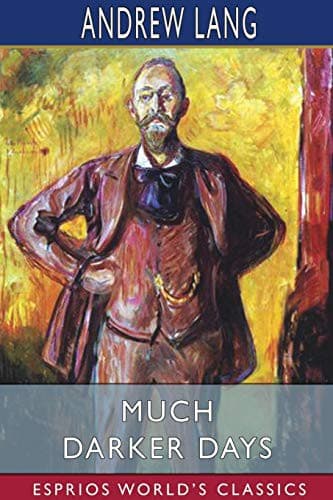
Conway, Hugh, 1847-1885. Dark days -- Parodies, imitations, etc.
The case is almost unique; but, had things fallen out otherwise, this
story could never have been got ready in time to romp in before the
other Christmas Annuals.
Matters would have become really _too_ complicated!
As Philippa recovered, it became more and more evident even to the most
dilatory mind that the sooner she left the scene of her late unrehearsed
performance the better.
The baronet had not yet been missed--indeed, he never _was_ missed, and
that is one of the very most remarkable points in the whole affair.
When he _did_ come to be missed, however, he would naturally be sought
for in the neighbourhood of the most recent and attractive of his wives.
That wife was Philippa.
Everything pointed to instant flight.
But how was I to get Philippa to see this? _Ex hypothesi_ she knew
nothing of the murder. On the other hand, all her pure, though
passionate nature would revolt against sharing my home longer than was
necessary. But would not the same purity prevent her from accompanying
me abroad?
Brother and sister we had called ourselves but Philippa had never been
the dupe of this terminology.
Besides, was not her position, in any case, just a little shady?
An idea now occurred to me for the first time. Many men would long ere
now have asked their mothers to _chaperon_ them. It flashed across me
that I had a mother.
He who says ‘mother’ says ‘chaperon.’
I would take my Philippa to my mother. Philippa was now completely
convalescent.
I can only attribute my lingering to the sense of fatality that all
things would come round and be all square.
Love I had laid aside till I could see my way a little clearer in
the certainly perplexing combination of circumstances. Nevertheless,
Philippa, I say it advisedly, seemed to me a good deal more pure and
innocent than when we first met. True, she had been secretly married to
a man under a name which she knew to be false.
True, she had given birth to a baby whose later fate remains a mystery
even to this day. True, her hands were stained with the blood of Sir
Runan Errand.
But why speak of Redistribution, why agitate for Woman’s Suffrage, if
trifles like these are to obstruct a girl’s path in society?
Philippa’s wrongs had goaded her to madness. Her madness was responsible
for the act. She was not mad any longer. Therefore she was not
responsible. Therefore Philippa was innocent.
If she became mad again, then it would be time to speak of guilt.
But would these arguments be as powerful with a British as they
certainly would have proved with a French jury?
Once Philippa seemed to awaken to a sense of the situation.
Once she asked me ‘How she came to my home that night?’
‘You came _out of_ the whirling snow, and _in_ a high state of
delirium,’ I answered, epigrammatically.
‘I thought I came on foot,’ she replied, dreamily.
‘But, Basil,’ she went on, ‘what afterwards? What’s the next move, my
noble sportsman?’
What, indeed! Philippa had me there.
Clearly it was time to move.
Public-domain text, read in full here on John Shaqi.
Reviews
Reviews
No reviews yet
Be the first to share your thoughts on this work.
Join the Discussion
Join the discussion
Sign in to leave a comment or review.
Sign InorCreate an account