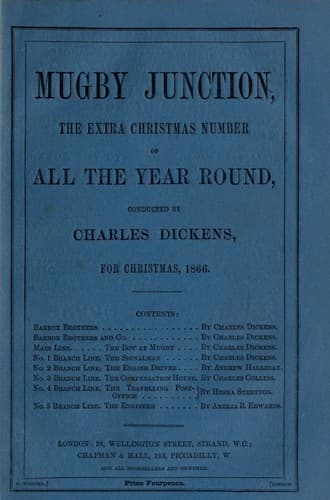
Psychological fiction; Railroad stations -- England -- London -- Fiction
Perfectly at ease and peace, Polly came along, but, finding the stairs
rather stiff work, was carried up by Barbox Brothers. The dinner was a
most transcendent success, and the Barbox sheepishness, under Polly’s
directions how to mince her meat for her, and how to diffuse gravy over
the plate with a liberal and equal hand, was another fine sight.
“And now,” said Polly, “while we are at dinner, you be good, and tell me
that story I taught you.”
With the tremors of a civil service examination on him, and very
uncertain indeed, not only as to the epoch at which the pie appeared in
history, but also as to the measurements of that indispensable fact,
Barbox Brothers made a shaky beginning, but under encouragement did very
fairly. There was a want of breadth observable in his rendering of the
cheeks, as well as the appetite, of the boy; and there was a certain
tameness in his fairy, referable to an under-current of desire to account
for her. Still, as the first lumbering performance of a good-humoured
monster, it passed muster.
“I told you to be good,” said Polly, “and you are good, ain’t you?”
“I hope so,” replied Barbox Brothers.
Such was his deference that Polly, elevated on a platform of
sofa-cushions in a chair at his right hand, encouraged him with a pat or
two on the face from the greasy bowl of her spoon, and even with a
gracious kiss. In getting on her feet upon her chair, however, to give
him this last reward, she toppled forward among the dishes, and caused
him to exclaim as he effected her rescue: “Gracious Angels! Whew! I
thought we were in the fire, Polly!”
“What a coward you are, ain’t you?” said Polly, when replaced.
“Yes, I am rather nervous,” he replied. “Whew! Don’t, Polly! Don’t
flourish your spoon, or you’ll go over sideways. Don’t tilt up your legs
when you laugh, Polly, or you’ll go over backwards. Whew! Polly, Polly,
Polly,” said Barbox Brothers, nearly succumbing to despair, “we are
environed with dangers!”
Indeed, he could descry no security from the pitfalls that were yawning
for Polly, but in proposing to her, after dinner, to sit upon a low
stool. “I will, if you will,” said Polly. So, as peace of mind should
go before all, he begged the waiter to wheel aside the table, bring a
pack of cards, a couple of footstools, and a screen, and close in Polly
and himself before the fire, as it were in a snug room within the room.
Then, finest sight of all, was Barbox Brothers on his footstool, with a
pint decanter on the rug, contemplating Polly as she built successfully,
and growing blue in the face with holding his breath, lest he should blow
the house down.
“How you stare, don’t you?” said Polly, in a houseless pause.
Detected in the ignoble fact, he felt obliged to admit, apologetically:
“I am afraid I was looking rather hard at you, Polly.”
“Why do you stare?” asked Polly.
“I cannot,” he murmured to himself, “recall why.—I don’t know, Polly.”
Public-domain text, read in full here on John Shaqi.
Reviews
Reviews
No reviews yet
Be the first to share your thoughts on this work.
Join the Discussion
Join the discussion
Sign in to leave a comment or review.
Sign InorCreate an account