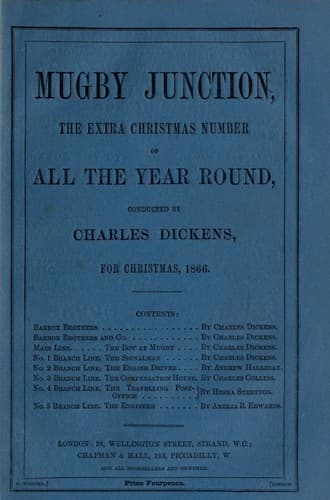
Psychological fiction; Railroad stations -- England -- London -- Fiction
It fell out somehow (perhaps he meant it should) that the walk tended to
the platform at which he had alighted, and to Lamps’s room. But Lamps
was not in his room. A pair of velveteen shoulders were adapting
themselves to one of the impressions on the wall by Lamps’s fireplace,
but otherwise the room was void. In passing back to get out of the
station again, he learnt the cause of this vacancy, by catching sight of
Lamps on the opposite line of railway, skipping along the top of a train,
from carriage to carriage, and catching lighted namesakes thrown up to
him by a coadjutor.
“He is busy. He has not much time for composing or singing Comic Songs
this morning, I take it.”
The direction he pursued now, was into the country, keeping very near to
the side of one great Line of railway, and within easy view of others.
“I have half a mind,” he said, glancing around, “to settle the question
from this point, by saying, ‘I’ll take this set of rails, or that, or
t’other, and stick to it.’ They separate themselves from the confusion,
out here, and go their ways.”
Ascending a gentle hill of some extent, he came to a few cottages.
There, looking about him as a very reserved man might who had never
looked about him in his life before, he saw some six or eight young
children come merrily trooping and whooping from one of the cottages, and
disperse. But not until they had all turned at the little garden gate,
and kissed their hands to a face at the upper window: a low window
enough, although the upper, for the cottage had but a story of one room
above the ground.
Now, that the children should do this was nothing; but that they should
do this to a face lying on the sill of the open window, turned towards
them in a horizontal position, and apparently only a face, was something
noticeable. He looked up at the window again. Could only see a very
fragile though a very bright face, lying on one cheek on the window-sill.
The delicate smiling face of a girl or woman. Framed in long bright
brown hair, round which was tied a light blue band or fillet, passing
under the chin.
He walked on, turned back, passed the window again, shyly glanced up
again. No change. He struck off by a winding branch-road at the top of
the hill—which he must otherwise have descended—kept the cottages in
view, worked his way round at a distance so as to come out once more into
the main road and be obliged to pass the cottages again. The face still
lay on the window-sill, but not so much inclined towards him. And now
there were a pair of delicate hands too. They had the action of
performing on some musical instrument, and yet it produced no sound that
reached his ears.
Public-domain text, read in full here on John Shaqi.
Reviews
Reviews
No reviews yet
Be the first to share your thoughts on this work.
Join the Discussion
Join the discussion
Sign in to leave a comment or review.
Sign InorCreate an account