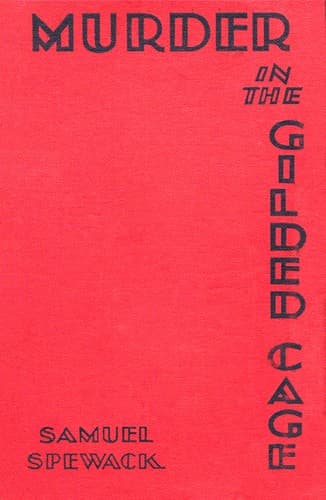
Americans -- Cuba -- Fiction; Detective and mystery stories; Havana (Cuba) -- Fiction; Murder -- Investigation -- Fiction
“Very well,” said Smith quietly. “It’s my duty to tell you, Mr.
Thomas, that in all my experience I have never seen a clearer case of
circumstantial evidence. You killed Mrs. Breese.”
CHAPTER IX
THIRD DEGREE
“But I didn’t kill anyone!” shouted the actor. “Good God, man, what do
you want from me? I’ve had enough!” His voice screeched protest.
“Sit down,” Smith ordered.
Reluctantly the actor obeyed, as if in a daze.
“I’ll tell you the facts as we have them now. If you can offer anything
to offset them, I’ll be very glad to hear what you have to say. But
this is the way the thing would appear in court:
“You are a member of Mrs. Breese’s household. Your status is peculiar.
The talk is that you’re her fiancé. But you have a sweetheart in New
York who expects to go to Europe with you. You have no money. Mr. Rice
and the National City Bank testify that they have seen a forged check
made out by you. Mr. Rice testifies that he telephoned Mrs. Breese
tonight informing her of the check. Mrs. Breese taxes you with it.”
“But she didn’t,” protested the actor. “I went upstairs while she was
still telephoning.”
“Why?”
“To write a letter to Miss Saunders. Mrs. Breese had agreed to give
me the money and I was sending a letter to Miss Saunders to tell her
everything was all set. Then, when I was about to come down again, the
butler ran up to tell me she had been killed!”
“You still deny you forged this check Mr. Rice mentioned?”
“Absolutely!”
“All right,” said Smith. “Let’s waive that. In any case, fifteen
minutes after Rice phoned here, Mrs. Breese is found dead. You’re
upstairs. The butler tells you that Mrs. Breese has been killed. You
don’t send for a doctor. Why? Because you knew already that Mrs. Breese
was dead. You send him for a policeman.”
“I didn’t think.”
“Perhaps not. In any case, Mr. Thomas, you had the opportunity to kill
Mrs. Breese, and if I am to believe Rice, you had the motive. I’m being
very frank with you.”
“But I didn’t do it! I didn’t do it!”
Smith shrugged his shoulders.
“Have you ever fired a revolver, Mr. Thomas?” he demanded.
“Have I ever--yes, in the army.”
“Are you a pretty good shot?”
“Not especially so, no. But I’ve never fired a revolver since. I never
even had one in my hand.”
I stared at Thomas, for at that moment I recalled one of the hectic
events of the yacht trip down.
“Don’t you remember,” I said, “that on the yacht you went into Henry
Breese’s cabin late at night and took a revolver from his luggage?”
“Oh!” the actor looked daggers at me. I, too, apparently had turned
against him. “That was after he tried to throw himself in the ocean,
and I knew he had a revolver, and I wasn’t taking any chances. So I
took it away from him.”
“What happened to that revolver?” Smith demanded.
“I threw it away that night.”
“Sorry to contradict you,” I said firmly. “You threw the cartridges
away. I distinctly remember seeing you put that revolver in your
pocket.”
“I threw it away later!”
Public-domain text, read in full here on John Shaqi.
Reviews
Reviews
No reviews yet
Be the first to share your thoughts on this work.
Join the Discussion
Join the discussion
Sign in to leave a comment or review.
Sign InorCreate an account