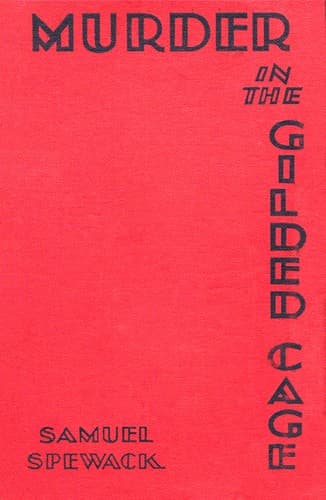
Americans -- Cuba -- Fiction; Detective and mystery stories; Havana (Cuba) -- Fiction; Murder -- Investigation -- Fiction
When we drew up before the Gilded Cage, we found an assorted crowd
of curiosity seekers lined up in front of us. Several of the native
newspaper men were sipping bacardi and coca-cola in the corner café
across the street. A lone and perspiring photographer was taking
pictures from all angles of the house of mystery. A murder sensation
was well under way.
Smith had notified the native police on guard of our coming, so we were
admitted without much delay. I led the Russian at his request into the
drawing-room and roughly mapped out for him the position of the body as
I had last seen it. We were alone.
One of the policemen told us that the family was upstairs, and we
left orders that we were not to be disturbed in our examination. As I
read off my copious notes of the day before, the Russian seemed only
casually interested. When I was done, he said: “It is a fallacy to take
so many notes. One does not see the forest for the trees, as you say in
your country. But thank you!”
Then he brushed me aside and began examining the furniture:
“Fine pieces!” he commented. “I have a love for expensive old
furniture. But what is this doing here?” He pointed to the black and
silver radio. “It is out of harmony. I do not like it.”
I could not very well point out to him that we were not there to
criticize the color scheme of the drawing-room. He walked about,
smoking his big cigar, examining the pictures and then pausing at the
bust of Mrs. Breese.
“What a woman!” he exclaimed, patting the stone head. “Unhappy woman!
Always restless, always scheming, never satisfied.” He shook his head
mournfully and then: “She had very poor taste! Very poor! In furniture,
in people.” Then he wheeled at me suddenly. “Behold! You think I am
wasting time? I am! I am getting my thoughts together. I see something.
What is more important, I feel something. I shall talk to you--I shall
think aloud, as we say. Behold the problem that confronts me. A woman
is murdered.
“There were fifteen servants and three members of the household,
the actor and two children. We take the actor first. The evidence
is overwhelming against him. He is a bad character. He has another
woman. He needs money. He has forged a check. He has been found out.
It is perfect! Too perfect! No man would commit murder under such
circumstances, at least if he were sane, and Mr. Thomas is stupid but
sane.
“Mr. Rice is the one who accuses Mr. Thomas. Now, where was Mr. Rice
last evening? That is important to know.”
“Why, you don’t for a moment think,” I said, “that Rice did it? He was
Mrs. Breese’s friend. Her adviser.”
“When a man accuses another of a murder, his hands must be clean.
Spotless. Where was Mr. Rice last night? That is what I ask.”
Public-domain text, read in full here on John Shaqi.
Reviews
Reviews
No reviews yet
Be the first to share your thoughts on this work.
Join the Discussion
Join the discussion
Sign in to leave a comment or review.
Sign InorCreate an account