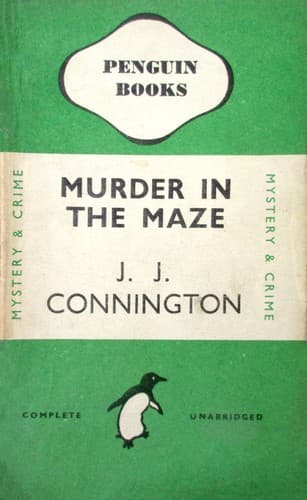
Country homes -- England -- Fiction; Detective and mystery stories; Murder -- Investigation -- Fiction
“I’m putting a hypothetical case, remember,” Sir Clinton cautioned
him. “This is what might be said—I don’t necessarily accept it myself.
I’m only trying to show you how it could be made to look, you
understand? Well, then, this secretary, Richard Roe, sooner or later
sees the chance which Providence has thrown in his way. His employer
is in the habit of drawing bearer cheques for large amounts—some
thousands—from time to time. And, rather carelessly, he has dropped
into the way of getting his secretary to cash them for him and bring
him the money. So the bank is accustomed to paying over these things
to the secretary, and no questions asked.”
Stenness gave no sign of special interest. His normal reserve was
sufficient to veil his thoughts.
“The secretary, we may assume, is an acute fellow. I think we may take
it that he may see a chance when it comes his way. But forgery
requires a certain amount of manual skill if it is carried out in some
ways; and possibly the secretary is sufficiently acute to distrust his
powers as a forger. But it’s always possible to trace a signature.”
Sir Clinton pulled out his cigarette case and lit a cigarette before
going on. He seemed determined to infuse informality into the
proceedings.
“It’s always possible to trace a signature,” he continued. “But one
needs a model signature for that—a signature from a cheque, of course,
because sensible people don’t use their letter signature on their
cheques. They have a special one with some specific trick in it—the
position of a dot, or something of the sort. I hope I’m not boring you
with these elementary things.”
“Not at all,” said Stenness, with a certain show of polite interest.
“The model, in the case of the secretary Richard Roe,” went on Sir
Clinton, “could easily be chosen from one of the old cheques returned
by the bank. He had access to these, we may suppose. But then comes in
a point which is sure to strike his acute mind. A man never writes his
signature twice in precisely the same way; there’s always a faint
difference between any two signatures. Hence, if two cheques turn up
with identical signatures, a sharp detective might suspect something
wrong. You follow me?”
Stenness nodded in silence.
“The acute secretary, Richard Roe, therefore traces his employer’s
signature from one of these old cheques. And to cover his trail, to
make certain that the thing cannot be shown to be a traced signature,
he then destroys the old cheque. Thus there are not two identical
signatures in existence; and the only thing missing is a cancelled
cheque—not a thing anyone is likely to make a fuss about at the worst,
even if its disappearance is noted. I make myself clear?”
“Quite,” said Stenness, still with his air of formal interest.
Public-domain text, read in full here on John Shaqi.
Reviews
Reviews
No reviews yet
Be the first to share your thoughts on this work.
Elsewhere in the archive
Join the Discussion
Join the discussion
Sign in to leave a comment or review.
Sign InorCreate an account