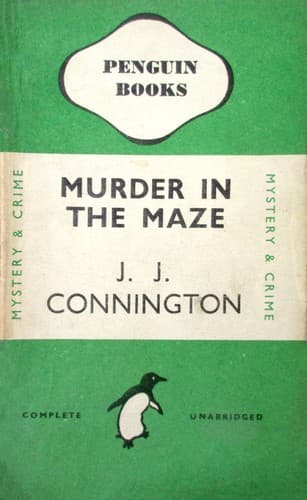
Country homes -- England -- Fiction; Detective and mystery stories; Murder -- Investigation -- Fiction
“So far, then,” Sir Clinton went on, “all is plain sailing. But now
comes a sticky bit. In fact, _the_ sticky bit of the whole affair.
Every cheque has its counterfoil; and Mr. John Doe, the employer, has
had an awkward habit of always filling in his counterfoils. Hence when
Mr. Richard Roe traces his employer’s signature on, let us say, cheque
No. 60073, he has to do something about the counterfoil of that
cheque. If he leaves it blank, it will catch the attention of the good
Mr. Doe the next time he uses the cheque-book. If the acute secretary
fudges an entry on counterfoil No. 60073, then Mr. Doe, who is by no
means a dull fellow, may spot the thing and cause trouble. What is to
be done? The obvious thing is to remove counterfoil No. 60073 from the
cheque-book and trust that its absence will not be noticed. I think
that is the course I’d have followed myself if I had got into that
fix.”
Sir Clinton seemed for a moment to lose interest in his narrative. He
sat for a time in silence, eyeing the secretary as though he hoped to
surprise something. But Stenness showed no sign of either guilt or
confusion.
“I congratulate you on your nerves, Stenness,” Sir Clinton began once
more. “Now that’s an hypothesis which I should not be very loath to
adopt as an explanation of this affair of the cheques. It seems to me
to cover the ground neatly. In fact, I’m quite convinced that it’s a
good hypothesis so far as it goes. But some people might be prepared
to carry it a stage further. I’ll just sketch out what they would
say.”
At this point Stenness seemed to find some interest in the matter. He
sat up and looked across at the Chief Constable.
“Please go on,” he requested.
“We have assumed that Richard Roe is an acute person. Now an alert
mind might quite conceivably see a further step which would bring him
on to safer ground. If things took their course, the forgery would be
spotted in a very short time. One can’t take thousands out of a man’s
account without raising inquiry. So, normally, the reasonable thing to
do would be to bolt and chance getting out of the country with the
cash. That’s what would occur to most people at once. But there’s
another way of making sure of things.”
Sir Clinton’s voice took on a graver tone.
“Let us suppose that immediately the cheque has been cashed, the
employer happens to die. What evidence of forgery is left then? None
whatever, if the tracing of the signature has been decently executed.
The supposed writer is dead; and no one else can deny his signature.
And the cheque, we assume, has been cashed before the death takes
place. On that basis, there would be no need for any flight on the
part of the forger. He would simply have to sit tight and behave
normally.”
Sir Clinton surprised a fresh look on Stenness’s face. It was only a
fleeting change; but it was quite unmistakable. But the secretary
remained obstinately mute and waited for the rest of the argument.
Public-domain text, read in full here on John Shaqi.
Reviews
Reviews
No reviews yet
Be the first to share your thoughts on this work.
Elsewhere in the archive
Join the Discussion
Join the discussion
Sign in to leave a comment or review.
Sign InorCreate an account