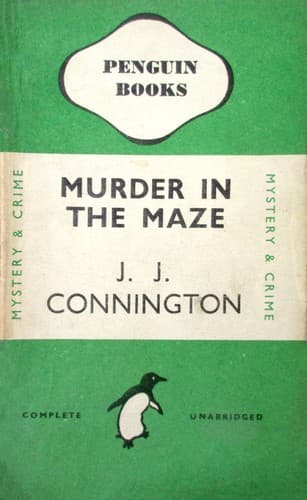
Country homes -- England -- Fiction; Detective and mystery stories; Murder -- Investigation -- Fiction
Howard Torrance, watching the Chief Constable, was surprised to see
that his eyes, instead of searching the ground, seemed to be ranging
over the surface of the hedge; and when Skene answered the question,
Sir Clinton’s thoughts appeared to be elsewhere. He turned to
Stenness.
“Can you take us to the other side of this hedge at that point?”
Stenness led the way once more into the Maze; and Sir Clinton found
that quite a considerable distance had to be traversed before they
reached the required position.
“This is the place?” he inquired, as Stenness came to a halt. “That’s
clear enough,” he added, as he stooped to pick something from the side
of the path. When he held it out, they recognised it as the bottom of
the tin box of which the lid had already been found. Sir Clinton
turned to the constables.
“Hunt about and see if you can find any more of these darts. You
mustn’t miss a single one, remember. And handle them carefully.
They’re deadly things, evidently.”
Then, as Stenness and Howard Torrance showed signs of joining in the
search, the Chief Constable stopped them with a gesture.
“I think we’ll leave the officials to do the work,” he said with a
certain finality in his tone.
Again he appeared to be more interested in the hedge itself than in
the roots where more darts might be hidden; and after a moment or two
he went forward and seemed to peer closely into the greenery at one
particular point. When he stepped back again, Howard moved forward in
curiosity; and Sir Clinton made way for him. As he brought his eye to
the position in which he had seen the Chief Constable’s, he looked
into a concealed loop-hole. The twigs had been trimmed away to form a
tunnel, the ends of which had been left covered with a thin screen of
leafage; and a glance through the aperture showed that it bore
directly on the chair in which Roger Shandon had been killed.
But already Sir Clinton seemed to have lost interest in the matter. He
whistled; and the dog which had been left behind in Helen’s Bower came
running to him.
“Have a sniff,” he invited the animal, holding out to it the part of
the tin box which he still held in his hand. “Now see what you can
make of it.”
He turned to his companions.
“It’s a poor chance. Don’t blame the animal if it fails.”
Part of Sir Clinton’s character was revealed in the whimsical apology.
He was always noted for his loyalty to his subordinates and his
readiness to recognise the impossibility of some tasks. It was the
complement to his sternness when he had to deal with inefficiency.
“That’s right! Good dog! He’s on to something!” Wendover announced
unnecessarily.
The beast had apparently picked up some scent or other, for it hurried
off along the alleys, followed by Sir Clinton and the other three men.
The constables were left to their search among the hedge roots.
It was anything but a simple route along which the dog led them; for
it seemed to wind backwards and forwards almost at haphazard.
Public-domain text, read in full here on John Shaqi.
Reviews
Reviews
No reviews yet
Be the first to share your thoughts on this work.
Join the Discussion
Join the discussion
Sign in to leave a comment or review.
Sign InorCreate an account