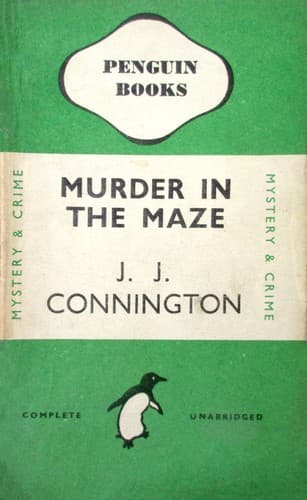
Country homes -- England -- Fiction; Detective and mystery stories; Murder -- Investigation -- Fiction
“When Neville Shandon looked into the room before going to the Maze,
he had a sheaf of papers in his hand. When I examined his body I
noticed a scrap of paper—a torn bit. I could read ‘Hackl . . .’ on it
in Neville’s writing, and a few other words as well.”
“That’s quite correct,” interrupted Sir Clinton, “I have it in my
pocket-book. And you infer . . . ?”
“I infer that that scrap is all that remains of his notes for his
cross-examination of Hackleton which was to come off this week.”
“In other words, you think someone in Hackleton’s pay is the murderer;
and the intention was to put Neville Shandon out of the case finally?”
“That’s your statement, not mine,” said Stenness, suddenly becoming
cautious. “But it’s been done before now.”
Sir Clinton nodded.
“You’re thinking of the shooting of Labori in the Dreyfus case, I
suppose?”
“That would be a parallel case to the one you sketched.”
“And the notes might be useful to Hackleton’s side as showing the
probable line of attack beforehand?”
Stenness maintained his caution.
“That’s your suggestion, not mine.”
“But assuming that,” demanded Sir Clinton, “why was Roger Shandon
murdered at all? He had nothing to do with the case.”
Stenness had his answer ready.
“Assume that twin brothers resemble each other closely and even dress
alike. Mightn’t a stranger mistake one for the other and kill him?
Obviously. And then he might find that he’d made an error if the
second brother turned up. The second man is the man he’s been paid to
put out of the way. Wouldn’t he finish his job?”
“That’s an ingenious theory, Mr. Stenness,” commented Sir Clinton, but
he refrained from saying anything further.
Howard Torrance had listened carefully.
“Hardly think that’ll fit, though. Neville was dead when I came across
him; and I’d just heard Roger shouting . . . at least . . . at any
rate,” he stumbled for a moment, then recanted. “No, you may be right.
I was confusing the order of finding the bodies with the order of the
murders.”
“There’s no proof of the order of the murders,” Stenness pointed out.
“Both of them were dead when they were found, and that’s all we know.”
At this moment steps sounded outside, the door opened noisily, and Sir
Clinton saw a stranger enter the room. At the sight of the air-gun in
the newcomer’s hand, Vera Forrest gave a slight exclamation.
“This is Sir Clinton Driffield, Mr. Hawkhurst,” Stenness hastened to
explain. “The Chief Constable.”
Arthur Hawkhurst leaned his air-gun against the wall and came forward.
“D’you usually travel with an escort, sir?” he inquired with a boyish
grin. “A bobby and a plain clothes man in the hall outside, I see.”
Then, turning to Stenness, he went on:
“Uncle Roger anywhere about? I owe the old man an apology. He’s rather
peevish with me over the piano, you know; and I must smooth him down.
Not let the sun go down on his wrath, et cetera.”
Public-domain text, read in full here on John Shaqi.
Reviews
Reviews
No reviews yet
Be the first to share your thoughts on this work.
Join the Discussion
Join the discussion
Sign in to leave a comment or review.
Sign InorCreate an account