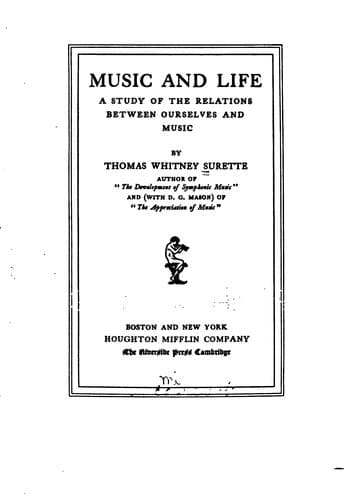
Music and Life: A study of the relations between ourselves and musicSurette, Thomas Whitney
History
Music and Life: A study of the relations between ourselves and music
Surette, Thomas Whitney
Music -- History and criticism
A fine singing voice has, perhaps, the most beautiful of all tone
colors, but the sensibility of many people seems to be limited to
that alone. In fact the love of singing is, in many cases, merely
a sentimental thrill unconnected with any intellectual process and
entirely devoid of imagination. In the orchestra the tone of the
instrument is to the theme itself what the color is to the rose. It
is much more than that, of course, because it is at any time both
retrospective and prospective; _this_ tone color is a darker or lighter
shade of _that_, or, perchance, another hue entirely. The colors shift
from moment to moment always as a part of the design rather than as
mere color.
Taking it all together--rhythm, meter, melody, harmony, and tone
color--this substance of a symphony is a wonderful thing. Nothing
quite so delicately organized has ever been created by the mind and
the imagination of man. With an interplay of parts almost equal to
that of a finely adjusted machine, it seems to go where it wills to go
regardless of anything but a whim. How marvelously does it express
both the actions and the dreams of human beings; how true is it to
their deeper consciousness--a consciousness that dimly fathoms both
life and death; that knows itself to have come from across the ages,
and feels itself to be a part of the ages to come. It is just as likely
that life is a brief, shadowed moment in an endless light, as that it
is “a rapid, blinking stumble across a flick of sunshine.”
FOOTNOTES:
[9] I stated in the first chapter what justification there is for using
the word “intellectual” in regard to music, and I speak here of thought
in that sense.
[10] As examples of melodies with finely adjusted rhythms I may cite
the theme of the slow movement of Beethoven’s pianoforte sonata, opus
13, and that of the slow movement of Brahms’s pianoforte quartette,
opus 60.
[11] In the “wood-wind” group, so called, there are flutes, oboe,
clarinets, bassoons, English horn, etc.; in the brass, there are
trumpets, French horns, trombones, tubas, etc.
CHAPTER VII
THE SYMPHONY (_continued_)
I. THE UNITY OF THE SYMPHONY
Public-domain text, read in full here on John Shaqi.
Reviews
Reviews
No reviews yet
Be the first to share your thoughts on this work.
Elsewhere in the archive
Join the Discussion
Join the discussion
Sign in to leave a comment or review.
Sign InorCreate an account