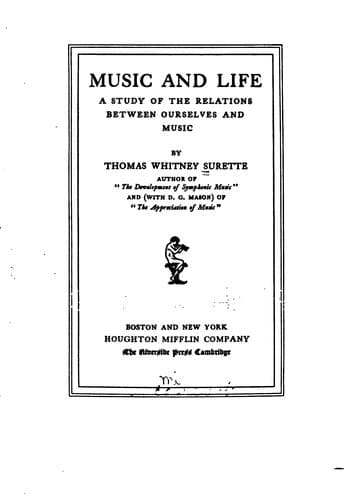
Music and Life: A study of the relations between ourselves and musicSurette, Thomas Whitney
History
Music and Life: A study of the relations between ourselves and music
Surette, Thomas Whitney
Music -- History and criticism
My object in writing all this about the form and substance of the
symphony, and in drawing comparisons between it and the novel or
poetry, has not been to lead my readers to understand music through the
other arts, for _by themselves_ such comparisons are of small value.
I have dwelt on these common characteristics of the arts because they
exist, because they illuminate each other, and at the same time because
they are too little considered. The only way to understand music is
to practice it, or, failing that, to hear it under such conditions as
will permit a certain opportunity for reflection. We are incapable
of understanding symphonic music chiefly because we have so little
practice in doing so. An occasional symphony concert is not enough.
How shall this difficulty be overcome? There is a natural way out,
and it consists in what is called “chamber music.” A piece of chamber
music is a sort of domestic symphony. A string quartette, a pianoforte
or violin sonata, a trio, quartette, quintette, etc.,--these are all
little symphonies; the form is almost identical, the same devices of
rhythm, melody, harmony, counterpoint, and so forth, are employed. In
chamber music paucity of idea cannot be covered up by luxury of tone
color; everything is exposed; so that only the greatest composers have
written fine music in this form. Now, if in every community there
were groups of people who played chamber music together, and if these
would permit their friends to attend when they practice, the symphony
would soon find plenty of listeners. Such rehearsals would give an
opportunity to hear difficult passages played over and over again;
there would be time for discussion, and, above all, for reflection.
Every town and village should have a local chamber-music organization
giving occasional informal concerts. Under these circumstances a
sympathetic intimacy would soon be established between the performers
and listeners and the music itself. The inevitable and indiscriminate
pianoforte lesson is an obstacle to this much desired arrangement. Some
of our children should be taught the violin or the violoncello in
preference to the pianoforte. Then the family circle could hear sonatas
for violin and pianoforte by Bach, Mozart, Beethoven, or Brahms, and
would accomplish what years of attendance at symphony concerts could
not bring about. Chamber music has the great advantage of being simple
in detail; one can easily follow the four strands of melody in a string
quartette, whereas the orchestra leaves one breathless and confused.
The practice of chamber music by amateurs would be one of the very best
means of building up true musical taste. I cannot dwell too insistently
on the fact that the majority of those people who do not care for such
music would soon learn to care for it if they had opportunities to
listen to it under such conditions as I have described. The argument
proves itself, without the evidence--plentiful enough--of individuals
Public-domain text, read in full here on John Shaqi.
Reviews
Reviews
No reviews yet
Be the first to share your thoughts on this work.
Elsewhere in the archive
Join the Discussion
Join the discussion
Sign in to leave a comment or review.
Sign InorCreate an account