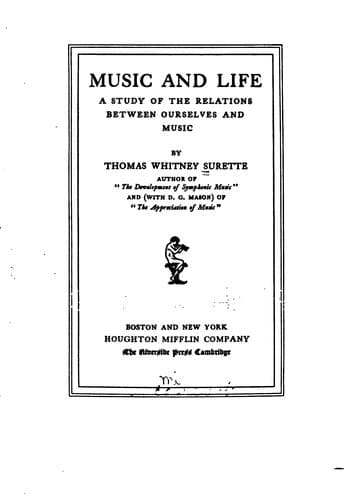
Music and Life: A study of the relations between ourselves and musicSurette, Thomas Whitney
History
Music and Life: A study of the relations between ourselves and music
Surette, Thomas Whitney
Music -- History and criticism
who have gone through the experience. Furthermore, by cultivating
music in this way, we should gradually break down some of the social
conditions which now operate against the art. If we all knew more about
it and loved it for itself, we should give over our present adulation
of technique. We should put the performer where he belongs as an
interpreter of a greater man’s ideas. By our uncritical adulations we
place him on far too high a pedestal.
IV. THE PERFORMER AND THE PUBLIC
I have spoken of certain social conditions which affect music
unfavorably. There has been always a certain outcry against music
because of its supposed emotionalism. The eye of cold intelligence,
seeing the music-lover enthralled by a symphony, raises its lid in icy
contempt for such a creature of feeling. The sociologist, observing
musical performers, wonders why music seems to affect the appearance
and the conduct of some of them so unfavorably. The pedagogue, who has
his correct educational formula which operates like an adding-machine,
and automatically turns out a certain number of mechanically educated
children, each with a diploma clutched in a nervous hand--he tolerates
music because it makes a pleasant break in diploma-giving at graduation
time, and because it pleases the parents. The business man leaves
music to his wife and daughters and is willing to subscribe to a
symphony orchestra provided he does not have to go to hear it play.
Now, if the sociologist would put himself in the place of the singer,
who, endowed by nature with a fine voice, is able, on account of a
public indifferently educated in music, to gain applause and an undue
source of money, even though he has never achieved education of any
sort whatever--if the sociologist would but think a little _about
sociology_, he would perhaps finally understand that he himself is very
likely at fault. For it is very likely that he knows almost nothing of
this art which is one of the greatest forces at his disposal. He is,
perhaps, one of the large number of persons who make musical conditions
what they are. Public performers are the victims, not the criminals. We
must remember of old how disastrous has been the isolation of any class
of workers from their fellows.
Public-domain text, read in full here on John Shaqi.
Reviews
Reviews
No reviews yet
Be the first to share your thoughts on this work.
Elsewhere in the archive
Join the Discussion
Join the discussion
Sign in to leave a comment or review.
Sign InorCreate an account