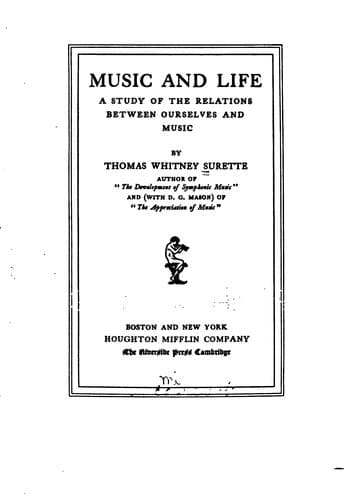
Music and Life: A study of the relations between ourselves and musicSurette, Thomas Whitney
History
Music and Life: A study of the relations between ourselves and music
Surette, Thomas Whitney
Music -- History and criticism
I have referred in this and in the preceding chapters to certain
unities in symphonic music--in its several elements of rhythm, melody,
and harmony, and in the whole. I have said that every object is unified
in itself, and that it is a part of a greater whole. In this sense a
symphony is a living thing; every member of it has its own function,
and contributes a necessary part to the whole. But is not this equally
true if we carry the argument into life itself and say: Here is a thing
of beauty created by man; it is a part of him--one of his star-gleams;
can he be complete if he loses it altogether? Can his spirit hope
for freedom if he depends on his mind alone? Is the satisfaction of
intellectual or material achievement enough? Would he not find in music
a realm where he would breathe a purer air and be happier because he
would leave behind him all those unanswerable questions which forever
cry a halt to his intelligence? Moral idealism is not enough for the
spirit of men and women, for, humanity being what it is, morality is
bound to crystallize into dogma. The Puritans were moral in their
own fashion, but they were as far away from what man’s life ought to
be--under the stars, and with the flowers blooming at his feet--as
were the gay courtiers whom they despised. Intellectual idealism is
not enough, because it lacks sympathy. We all need something that
shall be entirely detached from life and, at the same time, be wholly
true to it. Our spirit needs some joyousness which objects, ideas, or
possessions cannot give it. We must have a world beyond the one we
know--a world not of jasper and diamonds, but of dreams and visions.
It must be an illusion to our senses, a reality to our spirit. It must
tell the truth in terms we cannot understand, for it is not given to us
to know in any other way.
FOOTNOTE:
[12] The reason for this is one to which I referred in the chapter
on “The Opera”--namely, that a work of art must not overstrain the
capacities of those human beings for whom it was intended.
CHAPTER VIII
CONCLUSION
Public-domain text, read in full here on John Shaqi.
Reviews
Reviews
No reviews yet
Be the first to share your thoughts on this work.
Elsewhere in the archive
Join the Discussion
Join the discussion
Sign in to leave a comment or review.
Sign InorCreate an account