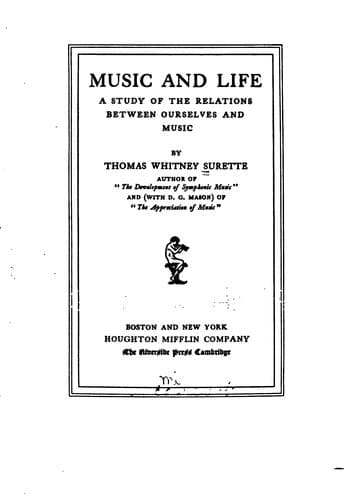
Music and Life: A study of the relations between ourselves and music — John Shaqi
Music and Life: A study of the relations between ourselves and musicSurette, Thomas Whitney
History
Music and Life: A study of the relations between ourselves and music
Surette, Thomas Whitney
Music -- History and criticism
And this condition is likely to increase rather than diminish as time
goes on, until, having finally arrived at moments of leisure and
finding that neither our money nor any other material possession gives
us any deep or permanent satisfaction, we turn to beauty only to be
confronted with the old warning: “Too late, ye cannot enter now.” For
we have arrived at the time when, in Meredith’s phrase, “Nature stops,
and says to us, ‘Thou art now what thou wilt be.’” For this capacity
for understanding and loving great books and paintings and music has to
grow with our own growth and cannot be postponed to another season. The
average American man is supposed to have no time for these things. He
has time, but he refuses to turn it into leisure,--leisure which means
contemplation and thoughtfulness,--though he very likely knows that
this has been accomplished over and over again by men who have saved
out of a busy life for that purpose a little time every day.
One recalls Darwin’s pathetic statement wherein he describes his
early love for poetry and music, and the final complete loss of
those “capabilities” through neglect. “The loss of these tastes,” he
says, “is a loss of happiness, and may possibly be injurious to the
intellect, and more probably to the moral character by enfeebling the
emotional part of our nature.”
The intellect of man, in itself, is never supreme or sufficient.
Feeling or instinct is half of knowledge. “Whoever walks a furlong
without sympathy,” says Whitman, “walks to his own funeral drest in
his shroud.” Of any man, American or otherwise, who lives his life
unmindful of all beauty we may justly say, as Carlyle said of Diderot,
“He dwelt all his days in a thin rind of the Conscious; the deep
fathomless domain of the Unconscious whereon the other rests and has
its meaning was not under any shape surmised by him.”
Must not the education of children in beauty begin, then, with their
parents? Must they not be aroused, at least, to an _intellectual_
conviction of its value, even though they have missed its joy?
Can the matter be safely left to the jurisdiction of the schools
themselves whose curricula are already overcrowded with methods of
escape from this very thing? Does not the school answer the general
conception of education obtaining among the fathers and mothers of the
school-children? Can it be expected--is it possible for it--to rise
far above that conception? My object is therefore to suggest, first,
that the perception of beauty is, in the highest sense, education;
second, that music is especially so, because it is the purest form of
beauty; and, third, that music is the only form of beauty by means of
which very young children can be educated, because it is the only form
accessible to them.
Public-domain text, read in full here on John Shaqi.
Reviews
Reviews
No reviews yet
Be the first to share your thoughts on this work.
Join the Discussion
Join the discussion
Sign in to leave a comment or review.
Sign InorCreate an account