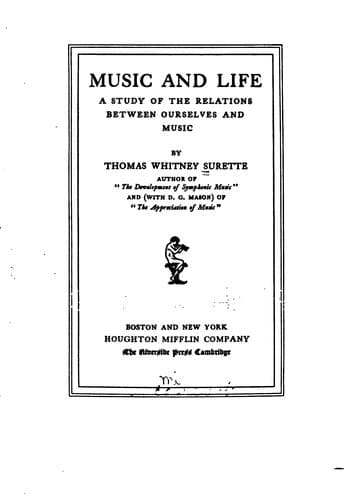
Music and Life: A study of the relations between ourselves and musicSurette, Thomas Whitney
History
Music and Life: A study of the relations between ourselves and music
Surette, Thomas Whitney
Music -- History and criticism
What are the claims of music as a means of educating the young? To some
educational administrators it seems to have almost no justification.
“What can be accomplished by it?” they ask. “Singing is not necessary
as a factor in life.” “Music is of little importance in a work-a-day
world.” So argue the school men who want “results” as they call them.
But the real object of education should be first to make human beings
capable of hearing and seeing intelligently, and of using their hands
skillfully, and then to train the mind so that it can receive and
assimilate knowledge and turn it into wisdom. There are a few school
authorities who see music as an important part of such education, but
most of them--being in themselves unconscious of its power and of its
value--only accept it because other people similarly placed have done
so, or as a relief from other studies, or as a means of enlivening
public school exhibitions. That there is something in our natures which
music fulfills and satisfies; that great men have given expression
to their ideas through it; that the understanding and appreciation
of their utterances depends on the training of the ear and of the
imagination, and that, when this training has been completed, a man
or woman has access to a whole world of beauty--all this the average
school man does not see. Nor can he be expected to see it, for he
has never experienced it in himself. But he should be convinced by
the phenomena; by the large number of people who derive enjoyment
and stimulation from great music; by the persistence of the love for
it; even, perhaps, by the colossal sums spent on it. But he cannot
dispel his distrust of a study whose results are illusive; he often
sees it badly administered, and is unable to remedy the condition, so
he leaves it to its fate. The one medium of human expression that is
universal, that transcends language, that knows no distinctions save
such as it seeks out itself in our own souls; that speaks to the
tiniest child and to his grandfather in common terms; that does _not_
deal in beliefs, or in dogma, or in events, or things, or persons, or
localities--this he suspects! Put all this on his educational scales; a
few lessons in arithmetic will outweigh it. The passion for categorical
facts, arranged in methodical sequence term by term, year by year, and
culminating in a sky-rocket burst, every fact blazing up separately for
an instant as though it really were alive, and then going out while
the charred embers fall far apart on a patient earth--this is called
Education! But this passion is almost ineradicable--is, indeed, one of
the most common of human failings. It is what is called in these days
“efficiency”: that is, a sort of nose-on-the-grindstone persistency in
detail entirely oblivious of those larger aspects of any case which
really decide its destiny. Systems, categories, precedents; these are
safe. Why wander from beaten paths? Individual aspiration, a desire for
Public-domain text, read in full here on John Shaqi.
Reviews
Reviews
No reviews yet
Be the first to share your thoughts on this work.
Join the Discussion
Join the discussion
Sign in to leave a comment or review.
Sign InorCreate an account