Music and Life: A study of the relations between ourselves and music — John Shaqi
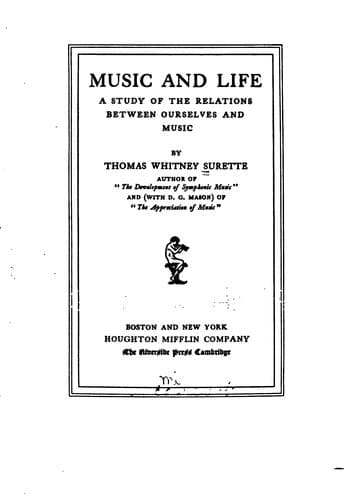
Music and Life: A study of the relations between ourselves and musicSurette, Thomas Whitney
History
Music and Life: A study of the relations between ourselves and music
Surette, Thomas Whitney
Music -- History and criticism
Sculpture is motion caught in a moment of perfection. Music is motion
always in perfection. This rhythm exists also in literature and the
other arts. Poe would be nothing without it; Whitman uses it in long
swelling undulations which are sometimes almost indistinguishable; the
composition in a great painting is a rhythm; the Apollo Belvedere is
all rhythm. But in music rhythm is a physical, moving property; rhythm
in being, not rhythm caught in a poise. The possibilities of rhythmic
play in music far exceed those in poetry, for in the latter the sense
or meaning would be clouded by too much rhythmic complication. It
would be impossible to do in poetry, for example, what Beethoven does
at the beginning of a movement in one of his string quartettes,[2]
where the ’cello, entirely alone, repeats one note fifteen times in
two rhythmic groups; there is no melody and no harmony--merely one
reiterated rhythmic sound. It is also impossible for poetry to present
three or four different rhythms simultaneously, as music often does;
nor can poetic rhythms carry across a complete rhythmic disruption
whose whole æsthetic sense lies in its relations to a permanent rhythm
which it momentarily violates, as is the case in the first movement of
Beethoven’s Third Symphony. In short, rhythm in music has a diversity,
a flexibility, and a physical vigor quite unparalleled in any other art.
Melody in music consists in a sequence of single sounds curved to some
line of beauty. Whereas rhythm is conceivable without any intellectual
quality,--as a purely physical manifestation,--melody implies some
sense of design, since it progresses from one point in time to another,
and without design would be merely a series of incoherent sounds. In
this design rhythm plays a leading part, and the themes having the
most perfect balance of rhythms are the most interesting. Examples
of diverse but highly coördinated melodies may be found in the slow
movement of Beethoven’s pianoforte sonata, Opus 13, and in Brahms’s
pianoforte quartette, Opus 60, the synthetic quality of which is like
that of a finely constructed sentence. Melody, being design, gives
conscious evidence of the personality of its creator. Schubert, for
example, is like Keats and represents the type of pure lyric utterance.
Bach, on the contrary, is essentially a thinker, and his melodies are
full of vigorous and diversified rhythms.
Public-domain text, read in full here on John Shaqi.
Reviews
Reviews
No reviews yet
Be the first to share your thoughts on this work.
Join the Discussion
Join the discussion
Sign in to leave a comment or review.
Sign InorCreate an account