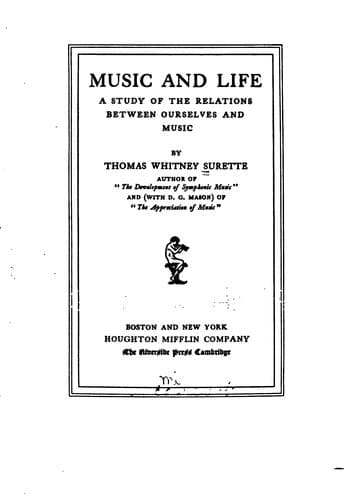
Music and Life: A study of the relations between ourselves and musicSurette, Thomas Whitney
History
Music and Life: A study of the relations between ourselves and music
Surette, Thomas Whitney
Music -- History and criticism
I take a form of pure music as a type of our highest attainment,
because when music is allied to words or to action it gives certain
hostages. Furthermore, the symphony evolved slowly under the law of
its own being, and it represents the application to music of those
general laws of proportion and balance, of unity and variety, which
govern all artistic expression. It has never been subjected to alien
influences; popularity has not been its motive power; virtuosity has
never dictated to it. If you understand the symphony you can apply that
understanding to any other form of music. If one compares it with the
opera this distinction is at once evident. In the opera that antagonism
of which Spencer speaks between states of feeling and of cognition does
exist, because the mind is there appealed to through objects rather
than through pure sound. The symphony speaks in its own terms; opera
speaks in terms of characters in action, of costume and of scenery,
as well as of music. Even the greatest operas cause you to reflect on
something outside themselves--on human motives as they find expression
in human action. In either “Don Giovanni” or “Tristan,” although the
music reaches great heights of beauty and is profoundly moving, there
is the inevitable struggle between seeing and hearing, the inevitable
difficulty between a simultaneous state of cognition and of feeling.
The symphony entirely escapes this dilemma. Np doubt great motives lie
beneath it; no doubt it, too, is a drama of human life, for otherwise
it could not be great as a work of art; but the play of motives in a
symphony is hidden behind the impenetrable veil of sound. The Third,
Fifth, and Ninth Symphonies of Beethoven are truly dramatic, but only
in this sense. They range from the tender to the terrible; they have
their own emotional climaxes; they philosophize, they brood, they grin
like a comic mask; action and reaction follow each other as in life
itself; nothing is lacking but that one inconsequential thing, reality.
Art is truth; life is but a shadow fading to nothingness as the sun
sets.
III. THE MATERIALS OF THE SYMPHONY
Public-domain text, read in full here on John Shaqi.
Reviews
Reviews
No reviews yet
Be the first to share your thoughts on this work.
Elsewhere in the archive
Join the Discussion
Join the discussion
Sign in to leave a comment or review.
Sign InorCreate an account