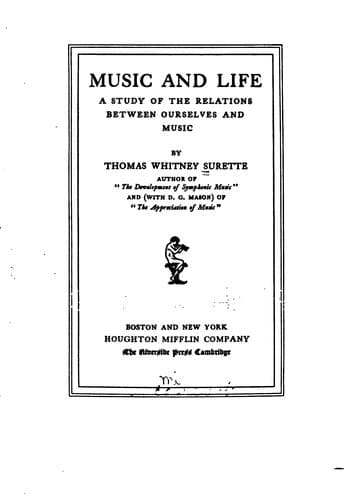
Music and Life: A study of the relations between ourselves and musicSurette, Thomas Whitney
History
Music and Life: A study of the relations between ourselves and music
Surette, Thomas Whitney
Music -- History and criticism
In writing about counterpoint I have dwelt on the rhythmic quality
in melody, and have stated that a well-defined and varied rhythm is
essential to contrapuntal treatment. I might almost have said that
all good melody depends on rhythm. I do say--expecting many a silent
protest from certain of my readers--that all the greatest melodies have
a finely adjusted rhythm, and I apply this statement to all melody
from the folk-song to the present time. I might enumerate beautiful
melodies whose effect depends on other properties than rhythm,--as the
second melody in Chopin’s Nocturne in G major, opus 37, number 2,--but
I should add that, as melody, existing by itself, it is not fine and
the reason is that its rhythm is monotonous.[10] And when I say it is
not fine, I mean that it is not highly imaginative, and that it depends
too much on its harmonization. And when, in turn, I say that, I mean,
perforce, that it is too emotional. The difference between such a theme
and one with a really fine rhythm is the difference between Poe’s “The
Raven” and Keats’s “Ode to a Grecian Urn.” In the former the mind is
being continually lulled by the soft undulation of the rhythms and
rhymes; in the latter the mind is being continually stimulated by their
complexities. Yet Keats’s ode is as unified as Poe’s lyric. There are
melodies for songs for the pianoforte, for the violin, and for the
orchestra; there are sonata melodies and there are symphonic melodies
just as there is a shape for a hatchet and a shape for a pair of
scissors--which is only stating once again the old law that the style
must suit the medium of expression, or that the shape must suit the
uses to which a thing is put. Symphonic themes, in contradistinction
to themes for songs or short pianoforte pieces, or dances, should be
inconclusive; they are valuable for what they presage rather than for
what they state, and they should indicate their own destiny. The four
notes with which the Fifth Symphony of Beethoven begins are so,--in
fact the whole theme is valueless by itself,--but they contain enough
pent-up energy to vitalize not only the first movement, but the three
which follow it. If it were possible for each reader of these words
to hear--as an interlude to his reading--a series of great symphonic
melodies, and if he would listen to them carefully, he would find
almost every one to contain a finely adjusted rhythm.
Public-domain text, read in full here on John Shaqi.
Reviews
Reviews
No reviews yet
Be the first to share your thoughts on this work.
Elsewhere in the archive
Join the Discussion
Join the discussion
Sign in to leave a comment or review.
Sign InorCreate an account