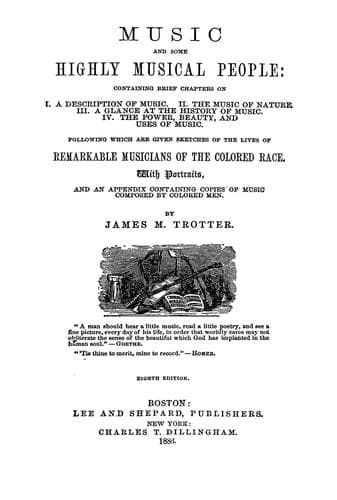
Music and Some Highly Musical PeopleTrotter, James M.
History
Music and Some Highly Musical People
Trotter, James M.
African American musicians -- Biography; African Americans -- Music
But I need not refer at greater length to these sweet harmonists of
Nature, since scarce an ear is so dull, and few hearts are so cold, as
not to be charmed and cheered by their unceasing, joyous melodies.
It might well be thought that flowers, those "fairy ministers of
grace," with their delicately tinted, variegated, perfect hues, that
emit, in their sweet, delicious perfumes, what may be called the
"breath of heaven," possess in these delightful qualities full enough
to instruct and charm mankind. But there is a flower, it seems, that,
inviting the aid of the evening zephyr, adds sweet music to its other
fascinating beauties. Let the poet Twombly sing of the music-giving--
BLUE HAREBELL.
Have ye ever heard in the twilight dim
A low, soft strain
That ye fancied a distant vesper-hymn,
Borne o'er the plain
By the zephyrs that rise on perfumed wing,
When the sun's last glances are glimmering?
Have ye heard that music, with cadence sweet
And merry peal,
Ring out like the echoes of fairy feet
O'er flowers that steal?
The source of that whispering strain I'll tell;
For I have listened oft
To the music faint of the blue harebell
In the gloaming soft:
'Tis the gay fairy-folk the peal who ring,
At even-time, for their banqueting.
And gayly the trembling bells peal out
With gentle tongue;
While elves and fairies career about
'Mid dance and song.
It would be tedious to enumerate and dwell upon all the very numerous
music-making agencies of the natural world; and I shall therefore
allude only to a few of those not already mentioned.
Many have heard the sounds of waterfalls, and know that from them
issues a kind of majestic music, which, to be appreciated, must be
heard. Musicians of finely-cultivated ears have studied the tones of
waterfalls; and two of them, Messrs. A. and E. Heim, say that a mass
of falling water gives
"The chord of C sharp, and also the non-accordant F. When C
and D sound louder than the middle note, F is heard very
fully, as a deep, dull, humming, far-resounding tone, with
a strength proportionate to the mass of the falling water.
It easily penetrates to a distance at which the other notes
are inaudible. The notes C, E, G, F, belong to all rushing
water, and in great falls are sometimes in different
octaves. Small falls give the same notes one or two octaves
higher. In the stronger falls, F is heard the most easily;
in the weak ones, C. At the first attempt, C is most readily
detected. Persons with musical cultivation, on attempting to
sing near rapidly-moving water, naturally use the key of C
sharp, or of F sharp if near a great fall."
Public-domain text, read in full here on John Shaqi.
Reviews
Reviews
No reviews yet
Be the first to share your thoughts on this work.
Join the Discussion
Join the discussion
Sign in to leave a comment or review.
Sign InorCreate an account