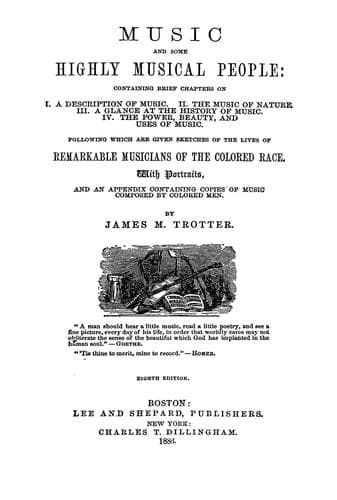
Music and Some Highly Musical PeopleTrotter, James M.
History
Music and Some Highly Musical People
Trotter, James M.
African American musicians -- Biography; African Americans -- Music
"The elegance, taste, and power of his performances, his
wonderful power of imitation, his extraordinary memory,--not
only of music, but of names, dates, and events,--his strict
adherence to what he believes to be right, his uniform
politeness, and his nice sense of propriety, afford, to
those who know him well, ample refutation of this opinion.
"Tom sometimes indulges in some strange gymnastics upon the
stage, which are considered by many a part of his stage
training. So far from this being the case, it is but a
slight outcropping of his usual exercises. If those who see
him upon the stage could witness his performances in his
room, and the enjoyment they afford him, they would perhaps
regret the necessity of his restraint in public. He never
engaged in the plays of children, or manifested any interest
in them. His amusements were all his own. With a physical
organization of great power and vigor, and an exuberance of
animal spirits, he naturally sought physical exercise.
Compelled by want of sight to limit himself to a small
space, he put himself in almost every conceivable posture,
and resorted to those exercises which required the most
violent physical exertion. They are now necessary certainly
to his enjoyment, perhaps to his health.
"Tom has been seen probably by more people than any one
living being. He has played in almost every important city
in the United States and in a great many of the smaller
towns, in Paris, and in most of the principal cities of
England and Scotland.... Those who have observed him most
closely, and attempted to investigate him, pronounce him a
'living miracle,' unparalleled, incomprehensible, such as
has not been seen before, and probably will never be seen
again."
I find, in reading his biography, that in Philadelphia and Pittsburgh,
in England and Scotland, scientists were asked to give an opinion as
to "Blind Tom's" musical genius. I select only one from these
opinions. The others (from Charles Halle, I. Moscheles, and Professor
H.S. Oakley, all very eminent musicians) agree with this one, and need
not be given.
PHILADELPHIA, Sept. 16, 1865.
DEAR SIR,--The undersigned desire to express to you their
thanks for the opportunity afforded to them of hearing and
seeing the wonderful performances of your _protege_, the
blind boy pianist, Tom. They find it impossible to account
for these immense results upon any hypothesis growing out of
the known laws of art and science.
Public-domain text, read in full here on John Shaqi.
Reviews
Reviews
No reviews yet
Be the first to share your thoughts on this work.
Elsewhere in the archive
Join the Discussion
Join the discussion
Sign in to leave a comment or review.
Sign InorCreate an account