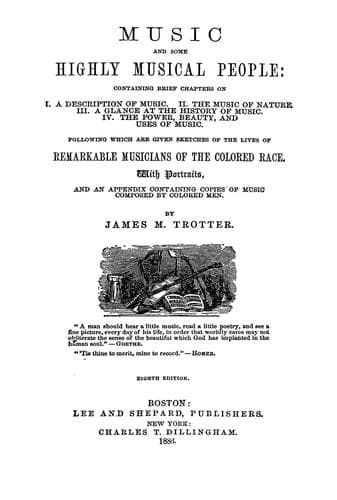
Music and Some Highly Musical PeopleTrotter, James M.
History
Music and Some Highly Musical People
Trotter, James M.
African American musicians -- Biography; African Americans -- Music
In the numerous tests to which Tom was subjected in our
presence, or by us, he invariably came off triumphant.
Whether in deciding the pitch or component parts of chords
the most difficult and dissonant; whether in repeating with
correctness and precision any pieces, written or impromptu,
played to him for the first and only time; whether in his
improvisations, or performances of compositions by Thalberg,
Gottschalk, Verdi, and others; in fact, under every form of
musical examination,--and the experiments are too numerous
to mention or enumerate,--he showed a power and capacity
ranking him among the most wonderful phenomena recorded in
musical history.
Accept, dear sir, the regards of your humble servants,
B.C. CROSS,
JAMES M. BECK,
G. BLANDNER,
J.A. STERN,
J.H. REDNOR,
CARL ROESE,
C. BLANCGAUR,
J.A. GETZA,
And several others.
Here are some clippings from American and English newspapers.
From "The Public Ledger," Philadelphia, Sept. 27, 1865:--
"Many professors of music of great eminence have been ready,
after listening to him, to declare that they would never
touch the piano again. What he has done in public in the way
of playing the most difficult pieces after hearing them but
once, and with a perfection that years of practice could not
usually apply, is known to all the lovers of music in this
city.
"The secret of this wonderful power is the most perfect ear
for the harmonies of sound ever observed,--'only this, and
nothing more.' To him every thing is music. Discords do not
seem to disturb him; but his ear catches every harmony, and
his whole being seems entranced and controlled by it. Let
him stand with his back to a piano, and any number of chords
be struck, and he will instantly tell every note sounded,
showing that he has been able to discriminate, and his
memory to retain distinctly and perfectly, each sound. The
phrenologists say that memory is in proportion to clearness
and strength of the impression produced at first; and this
must be the case with him. From two years old this
remarkable power of sound over him has been noticed. He has
been blind from birth; and it would seem here, as often
observed before, that, by a compensative law of our being,
in proportion as one sense is defective, the expenditure of
vital energy thus saved is absorbed by some other sense.
Probably all our sensations are the result of vibrations;
and the pulsations of light that usually enter and give all
their exquisite pleasure through the eye-ball are in his
case compensated for by the pulsations of sound, which
strike on an ear possessed of nerves of double delicacy and
vital energy from the absorption and concentration of two
senses in one.
Public-domain text, read in full here on John Shaqi.
Reviews
Reviews
No reviews yet
Be the first to share your thoughts on this work.
Elsewhere in the archive
Join the Discussion
Join the discussion
Sign in to leave a comment or review.
Sign InorCreate an account