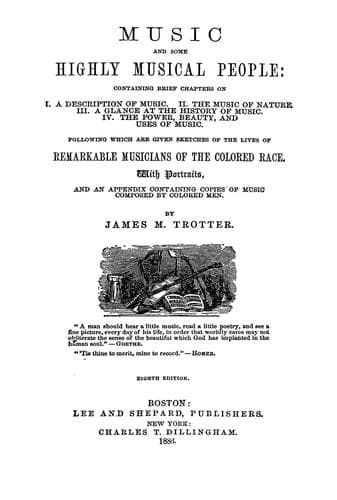
Music and Some Highly Musical PeopleTrotter, James M.
History
Music and Some Highly Musical People
Trotter, James M.
African American musicians -- Biography; African Americans -- Music
"Now test the power of analysis. Three pianos are opened: at
two of them persons present hammer away, with the design of
producing the most perfect discord imaginable; at the third
piano, the professor makes a run of twenty notes. The
confusion ceases, and Tom repeats in a moment each of the
twenty notes sounded. Still another test. Tom takes the
stool himself. With his right hand he plays 'Yankee Doodle'
in B flat. With his left hand he performs 'Fisher's
Hornpipe' in C. At the same time he sings 'Tramp, tramp,' in
another key,--maintaining three distinct processes in that
discord, and apparently without any effort whatever. 'Most
marvellous!' you say; 'but can he express as well as he
perceives?' The gentlemanly director will let you see. He
asks Tom to render 'Home, Sweet Home,' by Thalberg. You
know, that, of all productions in the current _repertoire_,
there are none which have finer or more difficult shades
than this. 'Blind Tom' proceeds; and, were you to close your
eyes, you could not tell but Thalberg himself was at the
instrument, so perfect and so exquisite is the conception
and the touch. Then you have renderings in imitation from
Chopin, from Gottschalk, from Vieuxtemps, from anybody you
will mention who has been deemed a master of the art; and
you turn away convinced, surfeited with marvels, satisfied
that you have witnessed one of the most incomprehensible
facts of the time."
From "The Manchester (Eng.) Courier," Sept. 26:--
"'Prodigies' of all kinds are presented ever and anon to the
public nowadays; but we have had nothing yet produced so
truly marvellous as the negro phenomenon known as 'Blind
Tom,' who appeared for the first time in Manchester, at the
Theatre Royal, last night. In order to test 'Blind Tom's'
powers of memory, Mr. Joule gave a short impromptu, avoiding
any marked rhythm or subject, but which was imitated very
cleverly. To test his powers of analyzing chords, Mr. Joule
played him the following discordant combinations: the chord
of B flat in the left hand, with the chord of A with the
flat fifth and sharp sixth in right hand; the chord of E in
the left hand, and the chord of D, two sharps, in the right;
the chord of A, three flats, in the left hand, with that of
A, three sharps, in the right. All these chords were at once
correctly named by enumerating each note in succession from
the lowest. Mr. Seymour subsequently was called upon, and
gave a subject, which he reproduced upon the piano-forte
with great success."
From "The Glasgow (Scotland) Daily Herald," Jan. 2, 1867:--
Public-domain text, read in full here on John Shaqi.
Reviews
Reviews
No reviews yet
Be the first to share your thoughts on this work.
Elsewhere in the archive
Join the Discussion
Join the discussion
Sign in to leave a comment or review.
Sign InorCreate an account