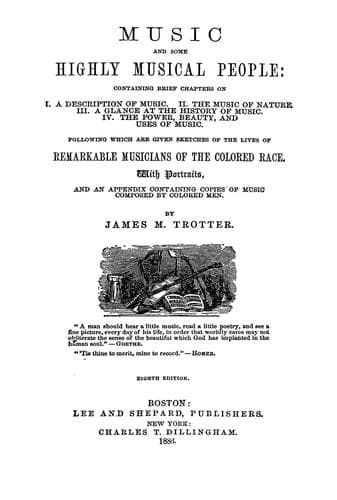
Music and Some Highly Musical PeopleTrotter, James M.
History
Music and Some Highly Musical People
Trotter, James M.
African American musicians -- Biography; African Americans -- Music
"'Blind Tom,' the wonderful negro-boy pianist, made his
_debut_ in Glasgow yesterday, when he gave three of his
entertainments, or rather musical exhibitions, in the
Merchants' Hall,--two during the day, and one in the
evening. He is, without doubt, an extraordinary lad; born
blind, though he is now able to distinguish light from
darkness; and having a defect in some of his mental
faculties, though what that defect is it is very difficult
to say. Nature seems to have made up for these deficiencies
by endowing him with a marvellously acute ear and a
retentive memory. It is not uncommon to find blind people
with their other senses much more highly developed, and much
more susceptible of impression, than in people possessing
all their faculties; but in no case have we ever heard or
known of one with auditory nerves so fine, or with memory so
powerful, as 'Blind Tom.' Mozart, when a mere child, was
noted for the delicacy of his ear, and for his ability to
produce music on a first hearing; but Burney, in his
'History of Music,' records no instance at all coming up to
this negro boy for his attainments in phonetics, and his
power of retention and reproduction of sound.... He plays
first a number of difficult passages from the best
composers; and then any one is invited to come forward and
perform any piece he likes, the more difficult the more
acceptable, and, if original, still more preferable. Tom
immediately sits down at the piano, and produces _verbatim
et literatim_ the whole of what he has just heard. To show
that it is not at all necessary that he should be acquainted
with any piece beforehand to reproduce it, he invites any
one to strike a number of notes simultaneously with the
hand, or with both hands; and immediately, as we heard him
do yesterday, he repeats at length, and without the
slightest hesitation, the whole of the letters, with all
their inflections, representing the notes. Nor are his
wondrous powers confined to the piano, on which he can
produce imitations of various instruments, and play two
different tunes--one in common time, and a second in
triple--while he sings a third; but he can with the voice
produce, with the utmost accuracy, any note which his
audience may suggest. Yesterday afternoon, for instance, he
was asked to sing B flat, F sharp, and the upper A,--a very
difficult combination; and, beginning with the latter, he at
once satisfied his auditors of his success. One very funny
feat he executed, which, as much as any thing else, showed
what he could do. When at Aberdeen, as Dr. Howard explained,
Tom heard, in a large ante-room adjoining the hall where he
was, a teacher of dancing tuning his fiddle, the strings of
which apparently had been rather difficult to get tightened
Public-domain text, read in full here on John Shaqi.
Reviews
Reviews
No reviews yet
Be the first to share your thoughts on this work.
Elsewhere in the archive
Join the Discussion
Join the discussion
Sign in to leave a comment or review.
Sign InorCreate an account