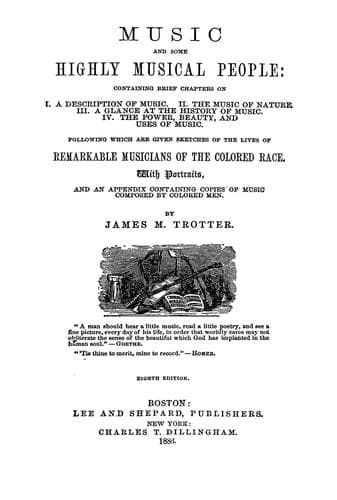
Music and Some Highly Musical PeopleTrotter, James M.
History
Music and Some Highly Musical People
Trotter, James M.
African American musicians -- Biography; African Americans -- Music
On the foregoing pages but little has been said of the secular songs
with which at times the troupe indulged their audiences. Even in music
of this kind they were exceedingly pleasing; and it is very
gratifying to reflect that the members of the company constantly
aimed to obtain a scientific knowledge of general music. No fears need
be entertained that the students of Fisk University will ever lack for
instruction in music of the highest order, as ample provision is there
made for the same. Of course the model of slave "spirituals" will in a
short while give place to such music as befits the new order of
things. The students themselves will wish to aim higher, as the spirit
of true progress will demand it. Nevertheless, some of the
characteristics displayed by the great Jubilee choir it will be well
for them to ever retain, and for all other singers to imitate: I mean
the heartiness, the soulfulness, of their style of rendition. Indeed,
in their striking exhibitions of these latter qualities, I think they
may justly claim the honor of standing quite peerless and alone, and
of having presented a model for the present and the future,--a model
founded on that power of the singer, which enables him to melt, to
stir to its innermost recesses, the human heart; that power that
enables him to sing as one inspired.
And here let me conclude by venturing a brief prediction. My mind goes
a few years into the future. I attend a concert given by students or
by graduates of Fisk University; I listen to music of the most
classical order rendered in a manner that would satisfy the most
exacting critic of the art; and at the same time I am pleasantly
reminded of the famous "Jubilee Singers" of days in the past by the
peculiarly thrilling sweetness of voice, and the charming simplicity
and soulfulness of manner, that distinguish and add to the beauty of
the rendering.
XX.
THE GEORGIA MINSTRELS.
"All the minstrel art I know,
I the viol well can play;
I the pipe and syrinx blow;
Harp and geige my hand obey;
Psaltery, symphony, and rote
Help to charm the listening throng;
And Armonia lends its note
While I warble forth my song."
_The Lay of the Minstrel._
The origin of troubadours, or minstrels, dates back to the year 1100
(A.D.) at least. There are accounts, somewhat vague, however, which
make them still more ancient. They were at one time almost the sole
producers of poetry and music, always composing the songs they sang,
accompanying the same generally, at first, with the music of the
dulcet-toned harp, and, at a later period, with that of the guitar.
Their accomplishments, especially in music, secured for them the ready
_entree_ of the most refined society, particularly that of elegant
ladies, of whom they were great favorites; while the most polished
princes always extended them a warm welcome.
Public-domain text, read in full here on John Shaqi.
Reviews
Reviews
No reviews yet
Be the first to share your thoughts on this work.
Elsewhere in the archive
Join the Discussion
Join the discussion
Sign in to leave a comment or review.
Sign InorCreate an account