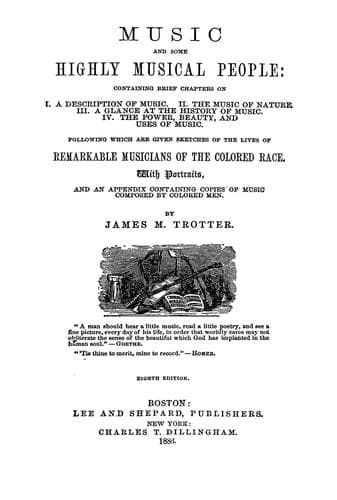
Music and Some Highly Musical PeopleTrotter, James M.
History
Music and Some Highly Musical People
Trotter, James M.
African American musicians -- Biography; African Americans -- Music
At one time in their history, the fate of letters was in the sole
keeping of the troubadours. Had it not been for the frequent
presentations and allusions made to literature in their songs, its
chain, connecting past and present, would have been broken.
An elegant French writer, speaking of the ancient troubadours,
observes, "They banished scholastic quarrels and ill-breeding,
polished the manners, established rules of politeness, enlivened
conversation, and purified gallantry. That urbanity that distinguishes
us (the French) from other peoples is the fruit of their songs; and,
if it is not from them that we derive our virtues, they at least
taught us how to render them amiable."
I have thus briefly alluded to the early history and characteristics
of the minstrel, because I consider such a course as just towards the
present profession, and in order to show how sadly (in this country
certainly) have its members deviated from the refined, the brilliant
practices of their predecessors. Besides, in doing this, I am not
without a hope that I may be contributing in some slight degree
towards elevating a profession, the archetypes of which discoursed the
finest music of their times, and whose courtliness of demeanor and
varied acquirements were such as to render them the fit associates of
persons of the highest culture. For, in this instance, why may not
what has been be again?
It is unnecessary to dwell at length upon the fact so sadly apparent,
that the American minstrel has had for his principal "stock in trade"
the coarse, the often vulgar, jest and song; a disgusting (to the
refined) buffoonery, attended with painfully displeasing contortions
of the body; and, worst of all, the often malicious caricaturing of an
unfortunate race.
It is, however, cause for gratulation, that American minstrelsy has of
late been divested of much of its former coarseness; that its
entertainments have become so much diversified and elevated in
character--the musical portions of which at times so nearly approach
the classical--as to render the same entirely different from the
minstrel performances so common a few years ago. It is found that a
public rapidly becoming enlightened, and freed from the influences of
an unreasoning and cruel race-hatred, no longer enjoys with its former
relish the "plantation act," so called, with all its extravagant and
offensive accompaniments. Compelled to recognize this change of
sentiment and taste, the best troupes now frequently give, instead of
the "act" just mentioned, some other one, which, while comical enough,
is yet free from features distasteful to people of refinement.
In view of all this, may we not ask, Is the minstrel guild going back
to the standards of its ancient and more noble days? Let us hope that
it is.
Public-domain text, read in full here on John Shaqi.
Reviews
Reviews
No reviews yet
Be the first to share your thoughts on this work.
Elsewhere in the archive
Join the Discussion
Join the discussion
Sign in to leave a comment or review.
Sign InorCreate an account