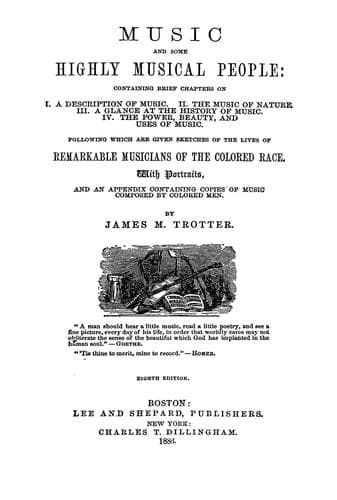
Music and Some Highly Musical PeopleTrotter, James M.
History
Music and Some Highly Musical People
Trotter, James M.
African American musicians -- Biography; African Americans -- Music
During the fourteenth century, music was most cultivated by the people
of the Netherlands, who carried the art towards much perfection,
producing several fine composers, and furnishing the leading musical
instructors for the other parts of Europe. Among some of the ablest
musicians of the Netherlands may be mentioned Dufay, Jan of Okenheim,
and Josquin Despres, the latter being the most celebrated of
contrapuntists. The Netherland musical supremacy lasted until 1563.
In the year 1400 the claims of music received the recognition of the
crown in England, a charter being granted to a regularly formed
musical society.
Commencing with the invention of movable type in 1502 (which invention
so vastly facilitated the publication and spreading of the thoughts of
the composer), and with the Reformation in the sixteenth century, the
noble art of music began a new, unimpeded, and brilliant career among
the civilized nations of the world. Dating from thence, the steps in
the progress of this delightful science can be plainly traced. Unvexed
and unfettered by the obscurities that attach to its antique history,
we can contemplate with pleasure and profit the wonderful creations
and achievements of its devotees.
This I need not attempt here, save in the briefest form; my purpose in
preparing this chapter being only to give, as indicated in the title,
a glance at the history of music.
To Palestrina, a learned Italian of the sixteenth century, and whose
musical genius and industry were most remarkable, is due the greatest
homage and gratitude of a music-loving world. Of him an eminent
musical writer says, "It is difficult to over-estimate his talent and
influence over the art of music in his day. He was regarded as the
great reformer of church music. His knowledge of counterpoint, and the
elevation and nobility of his style, made his masses and other
compositions, of which he wrote a great number, examples for all time
of what music should be."
In this century lived many notable composers, nearly all of whom
distinguished themselves in the production of madrigal music. To the
latter the English people were much devoted. Reading at sight was at
that day, even more than now, a common accomplishment among the
educated. The English queen Elizabeth was quite fond of music, and was
somewhat accomplished in the art, performing upon the lute, virginals,
and viol. She often charmed the _attaches_ of and visitors to her
court by her skilful performances. During her reign, and by her
encouragement, the cultivation of this noble art received a new and
strong impulse in England, and several composers and performers of
high merit lived.
In the year 1540 oratorio was first composed, followed by opera in
1594. During this period, instrumental music began to be used in the
churches; and the violin was brought by the celebrated Amati family to
a beauty of form, and sweetness of tone, not since excelled.
Public-domain text, read in full here on John Shaqi.
Reviews
Reviews
No reviews yet
Be the first to share your thoughts on this work.
Join the Discussion
Join the discussion
Sign in to leave a comment or review.
Sign InorCreate an account