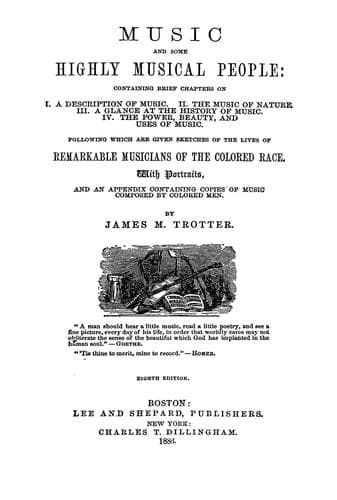
Music and Some Highly Musical PeopleTrotter, James M.
History
Music and Some Highly Musical People
Trotter, James M.
African American musicians -- Biography; African Americans -- Music
In referring to some among that galaxy of bright stars, I use, in
regard to Mozart, the clear and beautiful language of another:[5] "The
great musical composer Mozart was a wonderful instance of precocity,
as well as of surpassing genius. He died at the early age of
thirty-five, after a career of unrivalled splendor, and the
production of a succession of works which have left him almost, if not
entirely, without an equal among either his predecessors or those who
have come after him. Mozart's devotion to his art, and the
indefatigable industry with which, notwithstanding his extraordinary
powers, he gave himself to its cultivation, may read an instructive
lesson, even to far inferior minds, in illustration of the true and
only method for the attainment of excellence. From his childhood to
the last moment of his life, Mozart was wholly a musician. Even in his
earliest years, no pastime had any interest for him in which music was
not introduced. His voluminous productions, to enumerate even the
titles of which would occupy no little space, are the best attestation
of the unceasing diligence of his maturer years. He used, indeed, to
compose with surprising rapidity: but he had none of the carelessness
of a rapid composer; for so delicate was his sense of the beautiful,
that he was never satisfied with any one of his productions until it
had received all the perfection he could give it by the most minute
and elaborate correction. Ever striving after higher and higher
degrees of excellence, and existing only for his art, he scarcely
suffered even the visible approach of death to withdraw him for a
moment from his beloved studies. During the last moments of his life,
though weak in body, he was 'full of the god;' and his application,
though indefatigable, could not keep pace with his invention. 'Il
Flauta [Transcriber's Note: Flauto] Magico,' 'La Clemenza di Tito,'
and a 'Requiem' which he had hardly time to finish, were among his
last efforts. The composition of the 'Requiem,' in the decline of his
bodily powers, and under great mental excitement, hastened his
dissolution. He was seized with repeated fainting-fits, brought on by
his extreme assiduity in writing, in one of which he expired. A few
hours before his death took place, he is reported to have said, 'Now I
begin to see what might be done in music.'"
[Footnote 5: In the Library of Entertaining Knowledge, vol. iii. p.
76.]
Mozart's compositions number over six hundred, and two hundred of them
had not until quite recently been printed. He composed fifty-three
works for the church, a hundred and eighteen for orchestra, twenty-six
operas and cantatas, a hundred and fifty-four songs, forty-nine
concertos, sixty-two piano-forte pieces, and seventeen pieces for the
organ.
Public-domain text, read in full here on John Shaqi.
Reviews
Reviews
No reviews yet
Be the first to share your thoughts on this work.
Join the Discussion
Join the discussion
Sign in to leave a comment or review.
Sign InorCreate an account