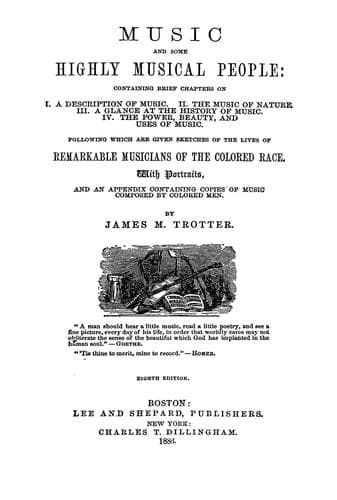
Music and Some Highly Musical PeopleTrotter, James M.
History
Music and Some Highly Musical People
Trotter, James M.
African American musicians -- Biography; African Americans -- Music
But, after all, we know not how soon another great musical genius may
startle us from our complacent studies of the masters of the past; for
we are even now somewhat threatened in this respect by Richard Wagner,
the eminent composer of Germany. He is not satisfied with the music of
the past nor the present, and points to his own present and
prospective creations as samples of what the "music of the future"
will be. Just now, musical critics, while generally conceding to him
much power as a composer, are divided in opinion as to whether his
ideas are to be accepted in their entirety.
Still, who can now tell what the "music of the future" _may_ be?
Before closing this chapter on the history of music, I think it highly
proper, as a matter of record and of appropriate interest, to refer
briefly to the almost wonderful achievements of that brilliant
impressario, P.S. Gilmore of Boston, who in the year 1869 conceived
the idea of having a grand musical festival, the noble objects of
which were to celebrate the restoration of peace in the United States,
and to quicken and increase the interest felt in music throughout this
country, and also the world, by bringing together in a single
performance a larger body of most skilful musicians than was ever
before attempted. An immense building called "The Coliseum" was
constructed for the purposes of the festival, which was to continue
five days. On the 15th of June, in the city of Boston, "The National
Jubilee and Great Musical Festival" was begun. The number of
instruments and performers composing the great orchestra was 1,011;
and an organ of immense proportions and power, built expressly for the
occasion, was employed. The grand chorus and solo vocalists numbered
1,040. Besides, one hundred anvils (used in the rendering of Verdi's
"Anvil Chorus") were played upon by a hundred of the city's firemen in
full uniform; while to all this was added a group of cannon, the same
being used in the performance of the "Star-spangled Banner." The vast
chorus, the orchestra, and all the leading performers (among the
latter were Ole Bull, Parepa, and Carl Rosa), were selected from the
finest musical people of the country, being accepted only after strict
testing by skilful judges. At this great gathering many of the works
of the great composers were performed, and only works of real merit
had a place on the programme. These were all performed by this vast
_ensemble_ with a precision and an excellence that were really grand
and wonderful. This achievement of Gilmore was considered the most
brilliant entertainment of modern times. Of it, it has been truly
said,--
Public-domain text, read in full here on John Shaqi.
Reviews
Reviews
No reviews yet
Be the first to share your thoughts on this work.
Join the Discussion
Join the discussion
Sign in to leave a comment or review.
Sign InorCreate an account