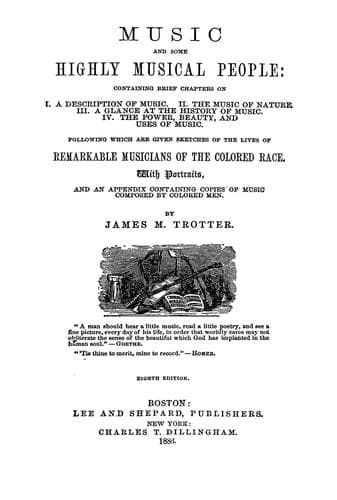
Music and Some Highly Musical PeopleTrotter, James M.
History
Music and Some Highly Musical People
Trotter, James M.
African American musicians -- Biography; African Americans -- Music
As before intimated, Wagner is not at all satisfied with pausing where
Mozart, Beethoven, and other great composers, left off. He believes
that their music can be improved upon. According to his theory, the
music of the opera, in the most highly-developed form of the latter,
is but an incidental element, the dramatic part being principal. He
lately composed a triology--three operas connected as one--with a
prologue, the subjects of the dramas being taken from mythology, and
forming beautiful fairy tales. To carry to the greatest perfection his
views and firmly-held ideas as to what music should be, and as to what
he stoutly avers it will be in the future, he selected from far and
near only the best artists for the performance of his opera (these
were subjected to long and careful rehearsals under his own
conductorship), and erected at Bayreuth, in Bavaria, a large and
beautiful theatre, which, in its minutest details even, was built
under his own supervision, and after his own peculiar ideas. It being
calculated to show to the highest advantage his conception, that, in
the expression of sentiment, music is only secondary, his orchestra of
one hundred and ten performers was placed out of sight of the audience
during the acting of the opera.
The great "Musical Festival," as it was called, continued three days,
the performance of each part of the triology occupying--exclusive of a
wait of one hour after each act--from four to five hours.
At these performances the nobility of Germany and other countries,
together with the Abbe Liszt, and many others in the higher walks of
music, were present. The audiences were immense, brilliant, and
exceedingly demonstrative in applause. At the close of the opera,
Wagner was called before the curtain, receiving quite an ovation: and
in his speech he said, "Now we see what can be done: at last we have a
German art."
It is perhaps too early, as yet, to decide that Richard Wagner's ideal
will be adopted by the musical world; nor should we be in too much
haste to conclude that it will not be. Certainly he has succeeded, at
least, in dividing the highest critics of the glorious art; and the
history of music shows, as does also that of all art, that what is
rejected to-day may be warmly and even rapturously accepted to-morrow.
Of the festival at Bayreuth, Mr. Hazard, musical critic of "The
New-York Tribune," writes, "The effect of the music was magnificent
beyond all description. It far surpassed all expectation; and the
general verdict is that it is a triumph of the new school of music,
final and complete."
Of the impression created by one of the parts of the opera,
"Rheingold" (Mr. F.A. Schwabe), of "The New-York Times," says,
"Musically considered, it is not significant. It is hopeless,
therefore, to look for popularity for the work; at present, at least."
Public-domain text, read in full here on John Shaqi.
Reviews
Reviews
No reviews yet
Be the first to share your thoughts on this work.
Join the Discussion
Join the discussion
Sign in to leave a comment or review.
Sign InorCreate an account