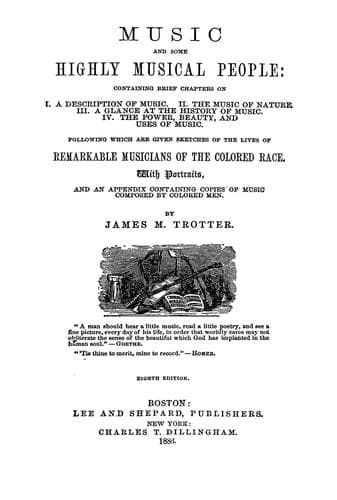
Music and Some Highly Musical PeopleTrotter, James M.
History
Music and Some Highly Musical People
Trotter, James M.
African American musicians -- Biography; African Americans -- Music
Mr. Theodore Thomas recently gave an excellent performance of the
works of American composers. Among those rendered were compositions by
Dudley Buck, A.H. Pease, and William Mason. One of the gems of the
evening was a symphonic poem by William H. Foy, entitled "A Day in the
Country."
Mr. Thomas's orchestra, noted for placing upon its programmes only
works of the highest merit, has recently also presented with much
success a new symphony by the talented composer of oratorios, &c.,
J.K. Paine.
In alluding to the progress of music in the United States, "The Music
Trade Review" says, "If the centennial year could disclose all its
triumphs, music would shine among its garlands. A hundred years ago
was a voiceless void for us compared with the native voices and native
workers who now know a sonnet from a saraband."
IV.
THE BEAUTY, POWER, AND USES OF MUSIC.
"The soul lives its best hours when surrounded by melody,
and is drawn towards its home, Paradise, dreaming of its
hymning seraphs who adore with ecstasies that can find
utterance only in song."
"And how can happiness be better expressed than by song or
music? And, if the body and mind are both attuned to a true
enjoyment of their resources, how much more will the moral
nature be refined and educated!"
The cultivation of the art of music has ever followed closely the
progress of civilization; and those nations that have attained to the
highest state of the latter have most encouraged the growth, and have
been most skilled in the creation and performance, of music.
Montesquieu avers that "music is the only one of all the arts that
does not corrupt the mind." Confucius said, "Wouldst thou know if a
people be well governed, if its laws be good or bad? examine the music
it practises." Again: another has quite aptly said that
"Music is one of the greatest educators in the world; and
the study of it in its higher departments, such as
composition, harmony, and counterpoint, develops the mind as
much as the study of mathematics or the languages. It
teaches us love, kindness, charity, perseverance, patience,
diligence, promptness, and punctuality."
And a writer in "Chambers's Journal" remarks, that
"In society, where education requires a submission to rule
singing belongs to the domain of art; but, in a primitive
state, all nations have their songs. Musical rhythm drives
away weariness, lessens fatigue, detaches the mind from the
painful realities of life, and braces up the courage to meet
danger. Soldiers march to their war-songs; the laborer
rests, listening to a joyous carol; in the solitary chamber,
the needlewoman accompanies her work with some love-ditty;
and in divine worship the heart is raised above earthly
things by the solemn chant."
Public-domain text, read in full here on John Shaqi.
Reviews
Reviews
No reviews yet
Be the first to share your thoughts on this work.
Join the Discussion
Join the discussion
Sign in to leave a comment or review.
Sign InorCreate an account