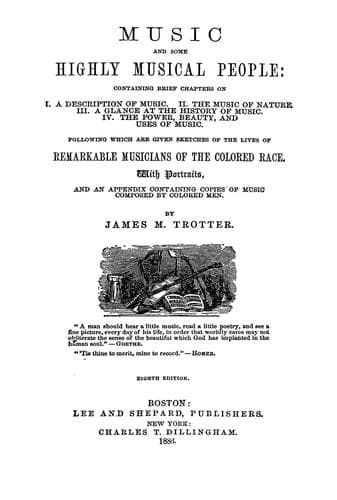
Music and Some Highly Musical PeopleTrotter, James M.
History
Music and Some Highly Musical People
Trotter, James M.
African American musicians -- Biography; African Americans -- Music
Nor need I dwell at great length upon the delights and benefits
afforded the members of families whose leisure is given to the study
and practice of an art so ennobling as music. How charming are those
homes in which it is, in its purest style, cultivated! what refinement
reigns therein! and what a gentle yet potent aid it is in parental
government! The allurements to outside and often harmful pleasures
lose their power over the children of that household in which music's
engaging, magic influence holds delightful, elevating sway. And then
at times, when instruments and voices mingle in a "concord of sweet
sounds," how delightful is the effect, how serenely beautiful is the
scene! Often have I, when passing in the evening a dwelling from which
floated out upon the air the notes of tuneful voices, accompanied by
the piano-forte or some other instrument, paused to listen, lingering
long, the ear so ravished by the sweet sounds as to cause me to stand
almost spell-bound, and to remain under music's magic influence even
after its charming sounds had died away.
"The music in my heart I bore
Long after it was heard no more."
To the great aid afforded them by music in government, the teachers in
our common schools can testify. Often a turbulent school, swayed by
youthful passions, or wearied by monotonous study into a state of
painful unrest, has been stilled, calmed, and refreshed by the
singing of a song,--an indulgence in the enjoyment of its melody
affording delightful relaxation, and also awaking to life that better,
that poetic sentiment that abides in every soul. The writer readily
recalls his own experience as a teacher in gently enforcing lessons in
polite deportment among his pupils by the aid of music. The exercises
of each session of his school were always begun and ended with song;
while sometimes, for reasons previously mentioned, books were laid
aside, and all joined in singing, even during a part of the time
usually devoted to study. By such procedure (the songs were of the
simplest kind, and without the adding charm of instrumental
accompaniment), even the most unruly pupils were generally induced to
yield to the softening influences of "magic numbers and persuasive
sound." In regard to the influence wielded over the mind and heart by
songs, an eminent writer thus speaks: "Songs have at all times, and in
all places, afforded amusement and consolation to mankind: every
passion in the human breast has been vented in song; and the most
savage as well as the most civilized inhabitants of the earth have
encouraged these effusions." The following description of the effects
of music at a reform-school is quite interesting in this connection.
It is clipped from a recent number of "The Boston Transcript."
Public-domain text, read in full here on John Shaqi.
Reviews
Reviews
No reviews yet
Be the first to share your thoughts on this work.
Join the Discussion
Join the discussion
Sign in to leave a comment or review.
Sign InorCreate an account