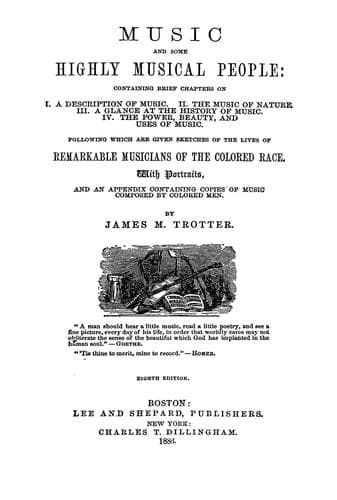
Music and Some Highly Musical PeopleTrotter, James M.
History
Music and Some Highly Musical People
Trotter, James M.
African American musicians -- Biography; African Americans -- Music
"In the storm, in the smoke, in the fight, I come
To help thee, dear, with my fife and my drum.
My name is Music: and, when the bell
Rings for the dead men, I rule the knell;
And, whenever the mariner wrecked through the blast
Hears the fog-bell sound, it was I who passed.
The poet hath told you how I, a young maid,
Came fresh from the gods to the myrtle shade;
And thence, by a power divine, I stole
To where the waters of the Mincius roll;
Then down by Clitumnus and Arno's vale
I wandered, passionate and pale,
Until I found me at sacred Rome,
Where one of the Medici gave me a home.
Leo--great Leo!--he worshipped me,
And the Vatican stairs for my feet were free.
And, now I am come to your glorious land,
Give me good greeting with open hand.
Remember Beethoven,--I gave him his art,--
And Sebastian Bach, and superb Mozart:
Join _those_ in my worship; and, when you go
Wherever their mighty organs blow,
Hear in them heaven's trumpets to men below."
T.W. PARSONS.
What is music? Quite easy is it to answer after the manner of the
dictionaries, and say, "Music is (1) a number of sounds following each
other in a natural, pleasing manner; (2) the science of harmonious
sounds; and (3) the art of so combining them as to please the ear."
These are, however, only brief, cold, and arbitrary definitions: music
is far more than as thus defined. Indeed, to go no farther in the
description of this really sublime manifestation of the beautiful
would be to very inadequately express its manifold meanings, its
helpful, delightful uses. And yet the impressions made upon the mind
and the depth of feeling awakened in the heart by music are such as to
render only a partial (a far from satisfying one) description of the
same possible, even to those most skilful and eloquent in the use of
language; for, in fact, ordinary language, after exhausting all of its
many resources in portraying the mind's conceptions, in depicting the
heart's finer, deeper feelings, reveals, after all, its poverty, when
sought to describe effects so entrancing, and emotions so
deep-reaching, as those produced by music. No: the latter must be
heard, it must be felt, its sweetly thrilling symphonies must touch
the heart and fill the senses, in order that it may be, in its
fulness, appreciated; for then it is that music is expressed in a
language of most subtle power,--a language all its own, and universal,
bearing with it ever an exquisitely touching pathos and sweetness that
all mankind may feel.
Public-domain text, read in full here on John Shaqi.
Reviews
Reviews
No reviews yet
Be the first to share your thoughts on this work.
Join the Discussion
Join the discussion
Sign in to leave a comment or review.
Sign InorCreate an account