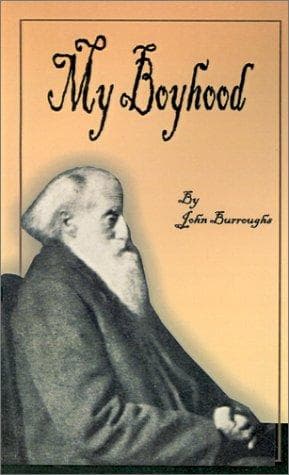
Burroughs, John, 1837-1921 -- Childhood and youth; Naturalists -- New York (State) -- Biography
At a much earlier stage of my mental development I had a passion for
drawing, but, quite unguided, it resulted only in a waste of paper. I
wanted to walk before I could creep, to paint before I could draw,
and getting a box of cheap water colours, I indulged my crude artistic
instincts. My most ambitious piece was a picture of General Winfield
Scott standing beside his horse and some piece of artillery, which I
copied from a print. It was of course an awful daub, but in connection
with it I heard for the first time a new word,--the word "taste" used
in its aesthetic sense. One of the neighbour women was calling at the
house, and seeing my picture said to Mother, "What taste that boy has."
That application of the word made an impression on me that I have never
forgotten.
About this time I heard another new word. We were working on the road,
and I with my hoe was working beside an old Quaker farmer, David Corbin,
who used to be a school teacher. A large flat stone was turned over, and
beneath it in some orderly arrangement were some smaller stones. "Here
are some antiquities," said Mr. Corbin, and my vocabulary received
another addition. A new word or a new thing was very apt to make its
mark upon my mind. I have told elsewhere what a revelation to me was
my first glimpse of one of the warblers, the black-throated blue-back,
indicating as it did a world of bird life of which I had never dreamed,
the bird life in the inner heart of the woods. My brothers and other
boys were with me but they did not see the new bird. The first time
I saw the veery, or Wilson's thrush, also stands out in my memory.
It alighted in the road before us on the edge of the woods. "A brown
thrasher," said Bill Chase. It was not the thrasher but it was a
new bird to me and the picture of it is in my mind as if made only
yesterday. Natural History was a subject unknown to me in my boyhood,
and such a thing as nature study in the schools was of course unheard
of. Our natural history we got unconsciously in the sport at noon time,
or on our way to and from school or in our Sunday excursions to
the streams and woods. We learned much about the ways of foxes and
woodchucks and coons and skunks and squirrels by hunting them. The
partridge, too, and the crows, hawks, and owls, and the song birds
of the field and orchard, all enter into the farm boy's life. I early
became familiar with the songs and habits of all the common birds, and
with field mice and the frogs, toads, lizards, and snakes. Also with the
wild bees and wasps. One season I made a collection of bumblebee honey,
studying the habits of five or six different kinds and rifling their
nests. I kept my store of bumble-bee honey in the attic where I had a
small box full of the comb and a large phial filled with the honey. How
well I came to know the different dispositions of the various kinds--the
small red-vested that made its nest in a hole in the ground; the
Public-domain text, read in full here on John Shaqi.
Reviews
Reviews
No reviews yet
Be the first to share your thoughts on this work.
Join the Discussion
Join the discussion
Sign in to leave a comment or review.
Sign InorCreate an account