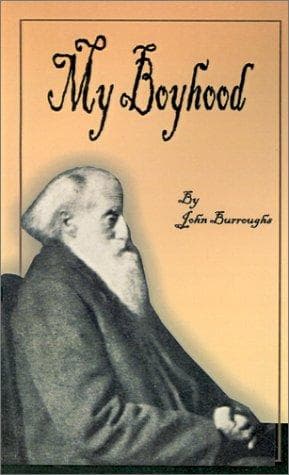
Burroughs, John, 1837-1921 -- Childhood and youth; Naturalists -- New York (State) -- Biography
My native mountain, out of whose loins I sprang, is called the Old
Clump. It sits there with bare head but mantled sides, looking southward
and holding the home farm of three hundred and fifty acres in its
lap. The farm with its checkered fields lies there like a huge apron,
reaching up over the smooth sloping thighs on the west and on the east
and coming well up on the breast, forming the big rough mountain fields
where the sheep and young cattle graze. Those mountain pastures rarely
knew the plough, but the broad side-hill fields, four of them, that
cover the inside of the western thigh, have been alternately ploughed
and grazed since my boyhood and before. They yield good crops of rye,
oats, buckwheat, and potatoes, and fair summer grazing. In winter huge
snow banks lie there just below the summit of the hill, blotting out the
stone fences beneath eight or ten feet of snow. I have known these banks
to linger there until the middle of May. I remember carrying a jug of
water one hot May day to my brother Curtis who was ploughing the upper
and steepest side hill, and whose plough had nearly reached the edge of
the huge snow bank. Sometimes the woodchucks feel the call of spring in
their dens in the ground beneath them and dig their way out through
the coarse, granulated snow, leaving muddy tracks where they go. I have
"carried together" both oats and rye in all these fields. One September,
during the first year of the Civil War, 1862, we were working in the
oats there and Hiram was talking hourly of enlisting in the army as a
drummer boy. When the cattle are grazing there, one may often see
them from the road over the eastern leg of Old Clump which is lower,
silhouetted against the evening sky. The bleating of the sheep in the
still summer twilight on the bosom of Old Clump is also a sweet memory.
So is the evening song of the vesper sparrow, which one may hear all
summer long floating out from these sweet pastoral solitudes. From one
of these side-hill fields, Father and his hired man, Rube Dart, were
once drawing oats on a sled when the load capsized while Rube had his
fork in it on the upper side trying to hold it down, and the fork with
Rube clinging to it described a complete circle in the air, Rube landing
on his feet below, none the worse for his adventure.
Public-domain text, read in full here on John Shaqi.
Reviews
Reviews
No reviews yet
Be the first to share your thoughts on this work.
Join the Discussion
Join the discussion
Sign in to leave a comment or review.
Sign InorCreate an account