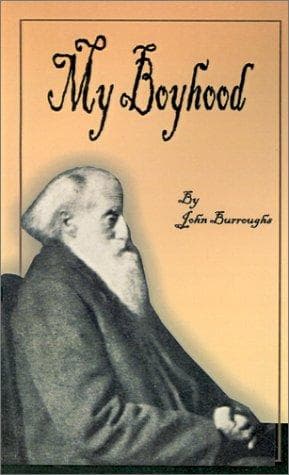
Burroughs, John, 1837-1921 -- Childhood and youth; Naturalists -- New York (State) -- Biography
I made a cross-gun that had a barrel (in the end of which you dropped
the arrow) and a lock with a trigger, and that was really a spiteful,
dangerous weapon. About my fifteenth year I had a real gun, a small,
double-barrelled gun made by some ingenious blacksmith, I fancy. But it
had fairly good shooting qualities--several times I brought down wild
pigeons from the tree tops with it. Rabbits, gray squirrels, partridges,
also fell before it. I bought it of a pedlar for three dollars, paying
on the instalment plan, with money made out of maple sugar.
On the wooded west side of Old Clump we used to hunt rabbits--really the
northern hare, brown in summer and white in winter. Their runways made
paths among the mountain-maple bushes just below the summit. On the
eastern side was a more likely place for gray squirrels, coons,
and partridges. Foxes were at home on all sides and Old Clump was a
favourite ground of the fox hunters. One day of early Indian summer,
as we were digging potatoes on the lower side hill, our attention was
attracted by someone calling from the edge of the woods at the upper
side of the sheep lot. My brothers rested on their hoe handles a moment
and I brushed the soil from my hands and straightened up from my
bent attitude of picking up the potatoes. We all listened and looked.
Presently we made out the figure of a man up by the edge of the woods
and soon decided from his excited voice and gestures that he was calling
for help. Finally, we made out that someone was hurt and the oxen and
sled were needed to bring him down. It turned out to be a neighbour,
Gould Bouton, calling, and Elihu Meeker, his uncle, who was hurt. They
were fox hunting and Elihu had fired at the fox from the top of a high
rock near the top of Old Clump and in his excitement had in some way
slipped from the rock and fallen on the stones fifteen or twenty feet
below and sustained serious injury to his side and back. With all
possible speed the oxen and sled were got up there and after long
waiting they returned to the house with Elihu aboard, groaning and
writhing on a heap of straw. The injury had caused him to bleed from his
kidneys. In the meantime Doctor Newkirk had been sent for and I remember
that I feared Elihu would die before he got there. What a relief I
felt when I saw the doctor coming on horseback, in the good old style,
running his horse at the top of his speed! "Now," I said, "Elihu will
be saved." He had already lost a good deal of blood, but the first
thing the doctor did was to take more from him. This was in times when
bleeding was about the first thing a doctor did on all occasions. The
idea seemed to be that you could sap the strength of the disease by
that means without sapping the strength of the man. Well, the old hunter
survived the double blood-letting; he was cured of his injury and cured
of his fox-hunting fever also.
Public-domain text, read in full here on John Shaqi.
Reviews
Reviews
No reviews yet
Be the first to share your thoughts on this work.
Join the Discussion
Join the discussion
Sign in to leave a comment or review.
Sign InorCreate an account