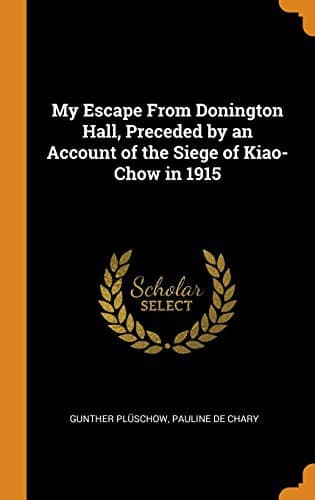
My Escape from Donington Hall, Preceded by an Account of the Siege of Kiao-Chow in 1915Plüschow, Gunther
History
My Escape from Donington Hall, Preceded by an Account of the Siege of Kiao-Chow in 1915
Plüschow, Gunther
Prisoner-of-war escapes; World War, 1914-1918 -- Personal narratives, German; World War, 1914-1918 -- Prisoners and prisons, British
A petty officer, who had also had some experience with airships, was
the only person, besides myself, who knew anything about it. After we
had unpacked all the cases, we went very carefully about filling the
balloons. And we were extremely proud when the first fat yellow sausage
lay stoutly lashed to the ground. I, personally, fastened every line
with my petty officer, and soon after this the yellow monster was
swaying lightly under the blue canopy of the sky. We hauled it down,
and I clambered alone into the gondola for the first ascent. On this
occasion I very nearly started on my complicated voyage to Germany,
for, when the order “Let go!” was given, the rope, which had been
measured out too generously, suddenly stiffened and got mixed up with
the cable, whilst the balloon shot out perpendicularly 50 metres into
the air. The thought that it was going to break away flashed through
my mind. A violent jerk nearly threw me out of the gondola. But as
the steel cable was also quite new it luckily held. So I was none the
worse, except for having gained some fresh experience.
I then started drilling and instructing my crew, and soon the show was
being run with the efficiency of old hands.
Our Governor expected great things of the observation balloon. It was
hoped that it would be of great service in reconnoitring the approach
of the enemy and the disposition of his artillery. These hopes were
doomed to disappointment, and my fears that the erection of the
balloons would serve no useful purpose proved only too justified.
Though I was able to send up the kite balloon to 1200 metres from the
ground, we did not succeed in visualizing the range of hills which lay
behind our fortified positions, thus observing the enemy’s movements
and, above all, the emplacement of his heavy siege artillery. And this
would have been of capital importance to the defenders of Kiao-Chow.
The Protectorate of Kiao-Chow lies on a narrow strip of promontory
which stretches out into the sea, with the town of Kiao-Chow framed
on three sides by the sea and partitioned off from the mainland by a
chain of mountains which has the form of a semicircle. They are the
Moltke, Bismarck and Iltis Mountains. Our chief position nestled among
their crannies, and at their foot lay the five infantry works with the
barbed-wire entanglements. Next came a wide valley, which was bisected
by the river Haipo, and next a new range of hills, which also stretched
from sea to sea and were doomed to bring disaster upon us. Behind them
there was another broad valley surmounted by the wild rocky tips of the
Lau-Hou-Schan, the Yung-Liu-Chui and the Lauchau.
Public-domain text, read in full here on John Shaqi.
Reviews
Reviews
No reviews yet
Be the first to share your thoughts on this work.
Join the Discussion
Join the discussion
Sign in to leave a comment or review.
Sign InorCreate an account