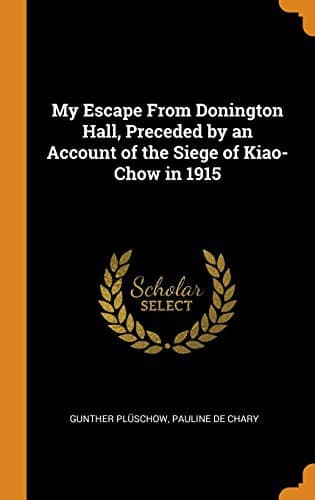
My Escape from Donington Hall, Preceded by an Account of the Siege of Kiao-Chow in 1915Plüschow, Gunther
History
My Escape from Donington Hall, Preceded by an Account of the Siege of Kiao-Chow in 1915
Plüschow, Gunther
Prisoner-of-war escapes; World War, 1914-1918 -- Personal narratives, German; World War, 1914-1918 -- Prisoners and prisons, British
I now started on my principal job—to reconnoitre the position of the
enemy’s heavy batteries.
Every day, whenever the weather permitted—and the propeller!—in the
early dawn, as soon as it was light, I started on my travels into
the unknown. And when the sun rose I hung like a silver speck high
up in the ether, circling for hours round the enemy’s positions,
and overlooking the whole of our beloved Protectorate invaded by an
impudent enemy, who meant to corner and destroy us.
My work was hard, but I enjoyed it, and it was crowned with success,
and the enemy’s unceasing efforts to shoot me down convinced me that I
_was_ successful.
As I mentioned before, I was now the only aviator at Kiao-Chow—“the
Master-Bird of Kiao-Chow,” as the Chinese called me. Also I had
but a single Taube at my disposal. I had to be careful and take no
unnecessary risks, otherwise there would have been an end to my job.
This was the way I carried out my reconnoitring.
As soon as I was flying right over the enemy I throttled my engine in
such a fashion that it kept the altitude of its own accord. I then hung
my map on the stick, took a pencil and a notebook, and observed what
was happening below through the space between the planes and the tail.
I let go the stick, and steered solely with my feet.
I then circled round a position until I had thoroughly mastered its
details, made a sketch of them, and entered them in my notebook. I
soon acquired such proficiency that I was able to write and draw
uninterruptedly for an hour or two. When I felt the back of my neck
getting stiff, I turned round and looked down on the other side. I
did this until I was satisfied with my notes, and sometimes I was so
carried away by my work that I had to be warned by a glance at my
petrol-recorder that it was high time I went home.
I always returned the same way. I flew round the wharves and the town
in proud circles, and when I reached my aerodrome I shut off the engine
and shot down to earth in a steep, gliding flight, which landed me safe
and sound in four minutes. For it was necessary to be quick. Infantry
and machine-gun fire were continuously directed at my aeroplane while
it flew over the enemy’s positions; when this proved of no avail, the
enemy used shrapnel, and this was most objectionable.
The Japanese always had new surprises in store for me. One day, for
instance—a day of blue sky and glorious sunshine—as I was returning
from a reconnaissance and about to land, I saw a great number of fleecy
white clouds, which looked perfectly delightful seen from above,
hovering over my aerodrome at an altitude of about 300 metres.
But I soon noticed that the Japanese were trying on one of their
little jokes, for these pretty cloudlets were caused by the firing of
10½-centimetre shrapnels!
Public-domain text, read in full here on John Shaqi.
Reviews
Reviews
No reviews yet
Be the first to share your thoughts on this work.
Join the Discussion
Join the discussion
Sign in to leave a comment or review.
Sign InorCreate an account